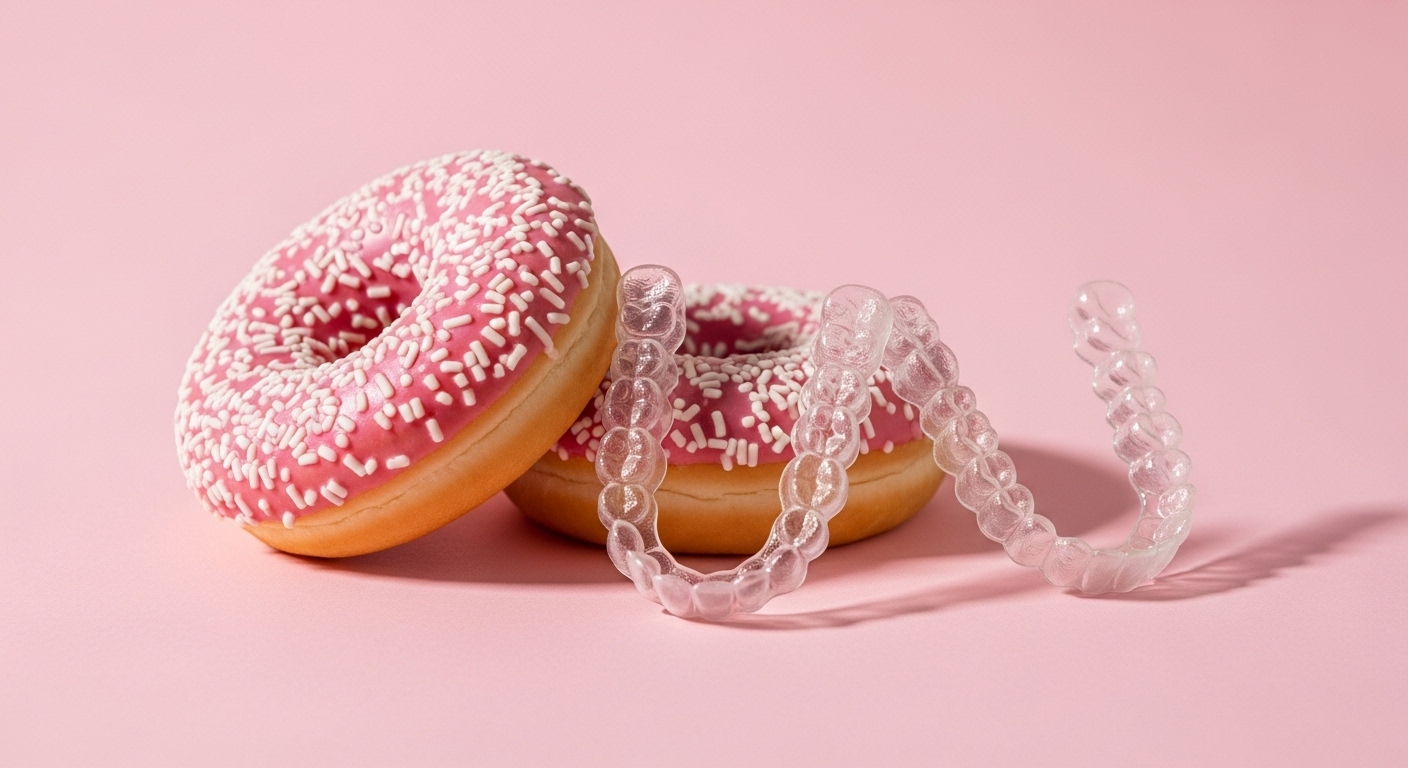
Eating With Invisalign: The Complete 2026 Food & Drink Guide
If you are used to the long list of forbidden foods that comes with traditional braces -- no popcorn, no caramel, no biting into apples -- Invisalign is a welcome change. Because the aligners are removable, you can eat anything you want during treatment. There are truly zero food restrictions. The catch? You need to follow a consistent routine of removing, eating, cleaning, and reinserting your aligners to keep treatment on track and protect your oral health.
This guide covers everything you need to know about eating and drinking during Invisalign treatment in 2026, from the daily routine to dining out in NYC restaurants, managing coffee habits, and maintaining the critical 20-22 hour daily wear time.
The Golden Rules of Eating With Invisalign
- • Food restrictions: None whatsoever -- eat anything you want
- • The one rule: Always remove aligners before eating or drinking (except plain water)
- • After eating: Brush teeth (or at minimum rinse), then reinsert aligners
- • Aligner storage: Always use the protective case -- never a napkin or pocket
- • Daily wear target: 20-22 hours, leaving 2-4 hours for meals and oral hygiene
Why Invisalign Has No Food Restrictions
The fundamental difference between Invisalign and braces when it comes to eating is simple: Invisalign aligners come out of your mouth before you eat. With braces, brackets are bonded directly to your teeth and wires thread between them -- hard foods can snap wires, and sticky foods can pull brackets loose. Repairs mean extra office visits and delayed treatment.
With Invisalign, you pop the aligners out, place them in your protective case, and enjoy your meal with completely unrestricted teeth. Every food that is off-limits with braces is perfectly fine during Invisalign treatment:
- Hard foods: Apples (biting directly into them), raw carrots, nuts, hard pretzels, ice
- Sticky foods: Caramel, taffy, gummy bears, toffee
- Crunchy foods: Popcorn, chips, corn on the cob, crusty bread
- Chewy foods: Bagels, pizza crust, beef jerky, licorice
This dietary freedom is consistently cited as one of the top reasons adults choose Invisalign over braces, especially in a city like New York where dining culture is central to social and professional life. For a full comparison of these two treatment approaches, see our Invisalign vs. braces guide.
The Invisalign Eating Routine: Step by Step
Within the first week of treatment, most patients develop an automatic routine that takes just a few minutes. Here is the complete process:
- Remove your aligners: Gently pull from the back molars first, then work forward. Place aligners immediately into your protective carrying case.
- Eat your meal: Enjoy anything you want -- no restrictions.
- Drink water during the meal: This helps rinse food particles as you eat.
- Brush your teeth: Use fluoride toothpaste. If possible, floss as well. If you cannot brush (dining out, for example), rinse your mouth thoroughly with water.
- Rinse your aligners: Quick rinse under lukewarm water before reinserting. For detailed cleaning guidance, see our Invisalign cleaning guide.
- Reinsert your aligners: Press firmly from front to back until they snap into place.
This routine becomes second nature within days. Many patients report that it actually improves their eating habits -- the conscious decision-making around meal timing reduces mindless snacking and encourages more structured eating patterns.
"The routine of removing and replacing aligners creates a mindfulness around eating that many patients find surprisingly beneficial. They become more intentional about what they eat, when they eat, and how they care for their teeth afterward."
What You Can and Cannot Drink With Invisalign In
While there are no food restrictions, there are strict rules about beverages. The short version: only plain water with aligners in. Everything else requires aligner removal. Here is why, broken down by beverage.
| Beverage | With Aligners? | Reason |
|---|---|---|
| Plain water (cold or room temp) | Safe | No sugar, no acid, no staining, no heat |
| Hot water / hot tea | Remove | Temperatures above 150F/65C can warp SmartTrack plastic |
| Coffee (hot or iced) | Remove | Stains aligners brown; acidic; hot versions warp plastic |
| Soda / sports drinks | Remove | Sugar trapped under aligners accelerates decay; phosphoric acid erodes enamel |
| Red wine | Remove | Instantly stains aligners dark purple/red; highly acidic (pH 3.0-3.5) |
| White wine / beer | Remove | Acidic; sugar content promotes cavity-forming bacteria under aligners |
| Juice / smoothies | Remove | High sugar, acidic, stains; fruit juice is as harmful to teeth as soda |
| Sparkling / flavored water | Remove | Carbonation is mildly acidic (pH 3-4); flavored varieties often contain citric acid |
Warning: Drinking sugary or acidic beverages with aligners in is worse than drinking them without aligners. The plastic traps the liquid against your tooth surfaces, bathing them in sugar and acid with no saliva to neutralize it. This can cause rapid enamel erosion and "rampant caries" -- multiple cavities forming simultaneously.
The Coffee Lover's Guide to Invisalign
Let us be honest: for many New Yorkers, the biggest Invisalign lifestyle question is not about food -- it is about coffee. If you are someone who sips a cup over two hours at your desk, you need a strategy.
The problem with coffee is threefold. First, it stains aligners. Even a single cup can turn clear plastic noticeably yellow-brown. Second, coffee is acidic (pH 4.5-5.0), and that acid trapped under aligners accelerates enamel erosion. Third, most people add sugar or cream, which feeds cavity-causing bacteria.
Practical Coffee Strategies
- Consolidate your coffee time: Instead of sipping throughout the morning, drink your coffee during one meal window. Remove aligners, enjoy your coffee with breakfast, brush afterward, and reinsert.
- Use a straw (aligners out): A straw directs coffee past your front teeth, reducing staining on your actual teeth -- helpful because aligners come off and teeth show.
- Rinse immediately after: If you cannot brush right away, swish water vigorously to clear acids and coffee residue from your teeth.
- Switch to a quick espresso: An espresso takes 2 minutes to drink versus 45 minutes of sipping a latte. Less time with aligners out means easier wear-time compliance.
- Cold brew through a straw: Removes the heat-warping risk entirely if you accidentally take a sip with aligners in.
Why You Must Remove Aligners Before Eating
Some patients, especially in the early days of treatment, wonder if they can just leave aligners in and eat soft foods. The answer is an emphatic no -- and not just because your orthodontist says so. The consequences are both expensive and clinically significant.
| Problem | What Happens | Cost / Consequence |
|---|---|---|
| Cracked or broken aligners | Chewing forces exceed what thin plastic is designed to handle | $50-$150 per replacement; 1-3 weeks wait for new tray |
| Warped aligners | Heat from hot food distorts the SmartTrack material | Poor fit means ineffective tooth movement; may need replacement |
| Trapped food and bacteria | Food particles compressed between aligner and teeth create bacterial breeding ground | Cavities, gum inflammation, bad breath |
| Accelerated tooth decay | Sugar sealed under plastic with no saliva access = rapid enamel breakdown | Dental fillings ($150-$500 each in NYC); potential treatment pause |
| Stained aligners | Turmeric, tomato sauce, coffee, and berries permanently discolor plastic | Defeats the "invisible" purpose; replacement needed for aesthetics |
Dining Out in NYC With Invisalign
New York City's restaurant scene is one of the best in the world, and Invisalign should not stop you from enjoying it. Whether it is a business dinner in Midtown, brunch in Williamsburg, or dim sum in Flushing, a simple routine keeps things smooth.
The Restaurant Routine
- Before food arrives: Excuse yourself to the restroom. Remove aligners over the sink (never at the table) and place them in your case.
- During the meal: Eat and drink whatever you want. No one at the table needs to know you are in orthodontic treatment.
- After the meal: Visit the restroom again. Brush with a travel toothbrush if you have one. If not, rinse your mouth thoroughly with water. Rinse aligners and reinsert.
The NYC Invisalign Dining Kit
Experienced Invisalign patients in New York always carry a small kit. Here is what to include:
- Protective aligner case: The single most important item. Order extras to keep in your bag, desk, and coat pocket.
- Travel toothbrush and mini toothpaste: Collapsible or folding options fit easily in a pocket or purse.
- Travel-size mouthwash: Clear, alcohol-free formula (colored mouthwash stains aligners).
- Floss picks or interdental brushes: Faster than traditional floss for a quick post-meal clean.
- A small water bottle: For rinsing when a sink is not immediately available.
Aligner Storage: The #1 Mistake to Avoid
- • Never wrap aligners in a napkin -- this is the most common way aligners get thrown away (a $50-$150 mistake)
- • Never put aligners in your pocket loose -- they can crack or get lost
- • Never leave them on the table or tray -- unsanitary and easy to forget
- • Always use the case -- order 3-5 extra cases from Amazon or your orthodontist
Managing Your 22-Hour Wear Time
Invisalign works through controlled, continuous force applied to your teeth. Align Technology's clinical guidelines call for 20-22 hours of daily wear for optimal tooth movement. That leaves just 2-4 hours per day for meals, snacks, and oral hygiene. Falling consistently below 20 hours per day can slow treatment, require mid-course corrections, or extend your treatment timeline by weeks or months.
Here is how to structure your day to hit the target:
| Meal Strategy | Aligners Out | Daily Wear Time |
|---|---|---|
| 3 meals, 30 min each + 15 min hygiene | ~2.25 hours | ~21.75 hours (excellent) |
| 3 meals, 45 min each + 15 min hygiene | ~3 hours | ~21 hours (good) |
| 3 meals + 1 snack, 45 min each | ~4 hours | ~20 hours (minimum acceptable) |
| Frequent snacking throughout day | 5+ hours | <19 hours (insufficient -- treatment delays) |
The practical takeaway: consolidate your eating into defined meals. Grazing and frequent snacking are the biggest threats to Invisalign wear-time compliance. Many patients find that structuring their eating this way actually benefits their nutrition and energy levels as well.
"The patients who struggle most with wear time are the constant snackers and all-day coffee sippers. I advise them to batch their eating and drinking into two or three windows. Once they do that, hitting 22 hours becomes easy."
What to Eat During Your First Week
While Invisalign has no permanent food restrictions, your teeth will likely be tender for the first 2-3 days after starting treatment (and sometimes after switching to a new aligner tray). This is normal -- the aligners are applying pressure to move your teeth, and the periodontal ligaments need time to adjust.
During these tender periods, you will be more comfortable with softer foods:
- Breakfast: Yogurt, scrambled eggs, oatmeal, smoothies, soft pancakes
- Lunch: Soup, soft pasta, rice bowls, avocado toast, hummus wraps
- Dinner: Fish, mashed potatoes, risotto, slow-cooked meats, steamed vegetables
- Snacks: Bananas, soft cheese, protein shakes, applesauce
After the initial adjustment period (usually 48-72 hours), tenderness subsides significantly and you can return to eating normally. Each time you switch to a new tray, you may experience a day or two of mild soreness, but it typically diminishes with each successive tray as your teeth adapt. For more on managing discomfort, see our Invisalign pain and discomfort guide.
The Invisalign "Diet" Effect
It is not marketed as a weight loss program, but many Invisalign patients report losing 5-15 pounds during treatment without intentionally dieting. A 2022 study published in the Journal of Clinical Orthodontics found that 35% of Invisalign patients reported unintentional weight loss during treatment. The mechanism is behavioral, not metabolic:
- Reduced snacking: The routine of removing aligners, eating, brushing, and replacing makes impulsive snacking far less appealing.
- Fewer sugary drinks: With only water allowed while wearing aligners, daily caloric intake from beverages drops significantly.
- Structured meals: Batch eating into defined meal windows eliminates mindless grazing.
- Conscious decision-making: Every eating occasion requires a deliberate choice to remove aligners, which introduces a pause that reduces emotional or boredom-driven eating.
This is a side benefit, not a guarantee, and should not be a primary reason for choosing Invisalign. But for patients who have struggled with snacking habits, the aligner routine can serve as a surprisingly effective behavioral nudge.
Warning: Do not skip meals to maximize wear time. Adequate nutrition is important for overall health and for the bone remodeling that makes tooth movement possible. If you find yourself skipping meals to avoid the aligner routine, speak with your orthodontist about strategies to maintain both nutrition and compliance.
Alcohol and Social Events
NYC nightlife and social events are part of the fabric of living here, and Invisalign should not keep you from participating. The rules for alcohol are the same as for other beverages: remove aligners first. Here are the specifics:
- Red wine: Instantly stains aligners. Always remove. It also stains teeth, so rinse your mouth with water between glasses.
- White wine and champagne: No staining risk, but highly acidic (pH 3.0-3.3). Remove aligners to prevent acid being sealed against enamel.
- Beer: Contains sugars and is mildly acidic. Remove aligners. Craft beers and stouts can also stain.
- Cocktails: Sugar content in mixed drinks is significant. Remove aligners. Drink water between cocktails to rinse.
- Clear spirits with soda water: Lowest-risk option, but still remove aligners due to alcohol content.
For social events where you will be drinking over several hours, accept that your wear time for that day will be lower. One evening out per week at 18-19 hours of wear will not derail your treatment, as long as you compensate with solid 22-hour days the rest of the week. Just avoid making it a daily occurrence.
Pro Tips From Experienced Invisalign Patients
- Use a timer app: Apps like TrayMinder or the official My Invisalign app track your daily wear time and send reminders when aligners have been out too long.
- Set aligner-out alarms: If you remove aligners for a meal, set a 45-minute phone alarm as a reminder to reinsert.
- Chew Movemints or sugar-free mints: Designed for Invisalign patients, Movemints help seat aligners and freshen breath without requiring removal. Regular gum sticks to aligners -- avoid it entirely.
- Embrace the routine: Patients who resist the routine find it annoying. Patients who build it into their daily rhythm barely notice it after the first week.
- Keep aligners in during cooking: Tasting food while cooking is fine as a quick sip or bite, but if you are doing extended tasting (a dinner party, for example), remove aligners.
Frequently Asked Questions
Yes. Unlike braces, Invisalign has zero food restrictions. You can eat popcorn, apples, nuts, sticky candy -- anything. The only rule is that you must remove your aligners before eating or drinking anything other than plain water. Put them back in after brushing your teeth.
Eating with aligners in can crack or warp the plastic, trap food particles against your teeth (accelerating decay), and stain the trays. A single accidental bite probably will not cause damage, but making a habit of it risks cracked aligners ($50-$150 to replace) and cavities.
No. Always remove your aligners before drinking coffee, tea, or any colored or hot beverage. Coffee stains aligners yellow-brown within days, the acidity damages enamel when trapped under plastic, and the heat can warp the aligner. Remove, drink, rinse your mouth, and replace.
You need to wear aligners 20-22 hours per day for treatment to stay on schedule. That leaves 2-4 hours per day for meals and oral hygiene. Keep individual meals to 30-60 minutes. If you eat three meals a day, budget about 45 minutes per meal including brushing.
Ideally, yes. Brushing removes food particles and sugars that would otherwise be trapped between your teeth and aligners, creating an environment for rapid cavity formation. If brushing is impossible (at a restaurant, for example), rinse your mouth thoroughly with water before reinserting aligners.
Sources
1. Align Technology — Invisalign SmartTrack Material Clinical Guidelines, 2025
2. Journal of Clinical Orthodontics — "Dietary Behavior Changes During Clear Aligner Therapy," 2022
3. American Dental Association (ADA) — Patient Education: Caring for Removable Orthodontic Appliances, 2024
4. American Journal of Orthodontics and Dentofacial Orthopedics — "Effect of Wear Time on Invisalign Treatment Outcomes," 2023
5. Journal of Dental Research — "Acidic Beverage Consumption and Enamel Erosion Under Orthodontic Appliances," 2024
6. Align Technology — Recommended Aligner Wear Time and Patient Compliance Data, 2025
7. American Association of Orthodontists (AAO) — Patient Care Guidelines for Clear Aligner Therapy, 2025
Conclusion
Eating with Invisalign is refreshingly simple: remove your aligners, eat whatever you want, brush your teeth, and put them back in. No food restrictions, no broken brackets from biting into an apple, no food stuck in wires. The freedom to eat normally is one of the most tangible advantages Invisalign offers over traditional braces.
The key to success is building a consistent routine and protecting your daily wear time. Within the first week, removing and reinserting aligners around meals will feel as automatic as putting on your shoes in the morning. And with a little planning -- a carrying case in your bag, a travel toothbrush at your desk -- eating out in New York City is completely seamless.
Ready to Start Invisalign in NYC?
Find a certified Invisalign provider near you for a free consultation and personalized treatment plan.
Find a Provider in NYC