What Is Invisalign? How Clear Aligners Work in 2026 (Complete Guide)
Invisalign has treated over 18 million patients worldwide since its introduction in 1998, making it the most widely used clear aligner system on the planet. But what exactly is it, how does the technology work, and is it the right treatment for your teeth? This comprehensive 2026 guide explains everything -- from the science behind SmartTrack material to the step-by-step treatment process, realistic costs in New York City, candidacy criteria, and what to expect at every stage of your journey.
Invisalign at a Glance (2026)
- • What it is: Custom clear plastic aligners that straighten teeth without metal brackets or wires
- • Material: Proprietary SmartTrack thermoplastic (FDA-cleared, BPA-free)
- • Wear schedule: 20-22 hours/day, switch every 1-2 weeks
- • Treatment time: 6-24 months depending on complexity
- • Cost in NYC: $4,000-$9,000 (comparable to braces)
- • Patients treated: 18+ million worldwide
What Is Invisalign?
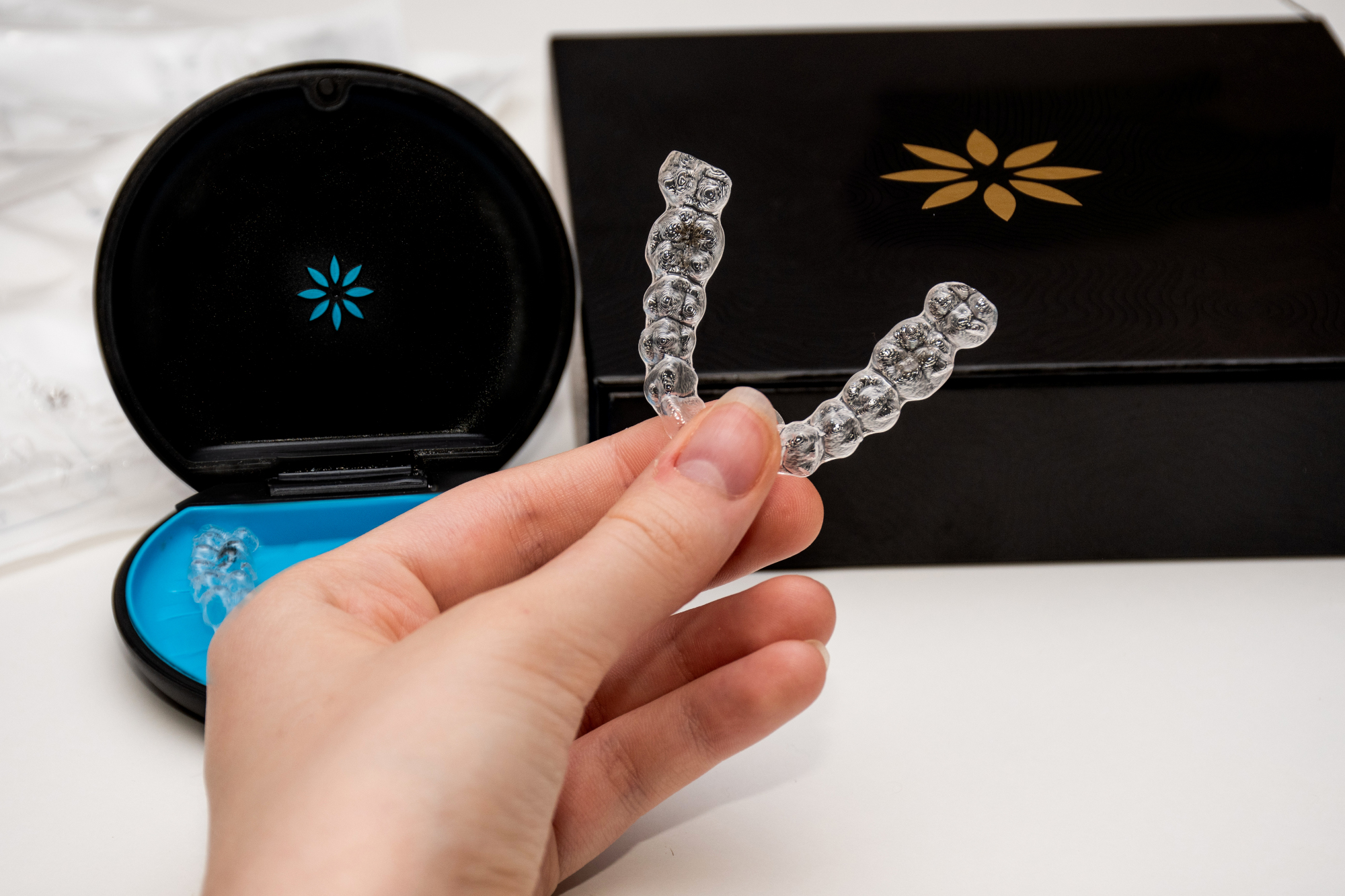
Invisalign is an orthodontic treatment system that uses a series of custom-fabricated, clear plastic aligners to move teeth gradually into their desired positions. Unlike traditional braces, which rely on metal brackets cemented to the teeth and connected by archwires, Invisalign aligners are removable, virtually invisible when worn, and designed to be switched out every one to two weeks as your teeth shift.
Each aligner in the series is slightly different from the last, engineered to accomplish a precise set of tooth movements. The cumulative effect of wearing 15 to 50+ sequential aligners (depending on case complexity) produces a complete orthodontic correction -- closing gaps, resolving crowding, and improving bite alignment -- all without a single bracket or wire.
Invisalign was developed by Align Technology, a medical device company founded in San Jose, California, in 1997. The system received FDA clearance in 1998 and has since become the most studied and widely prescribed clear aligner brand in the world. As of early 2026, more than 18 million patients across 150+ countries have been treated with Invisalign, and the company holds over 1,100 patents related to digital treatment planning and aligner fabrication.
How Does Invisalign Work? The Science Explained
Invisalign works through the same biological process as traditional braces: controlled bone remodeling. When steady, gentle pressure is applied to a tooth, the bone on one side of the tooth root resorbs (breaks down) while new bone forms on the opposite side. This allows the tooth to shift position within the jawbone over time. Invisalign simply delivers this pressure through custom plastic trays rather than fixed metal hardware.
What makes Invisalign's approach distinct is its reliance on digital precision. Every aspect of treatment -- from initial diagnosis to final aligner design -- is planned and manufactured using proprietary software and 3D printing technology. Here is how the process unfolds, step by step.
Step 1: Initial Consultation and 3D Digital Scanning
Your treatment begins with a visit to a certified Invisalign provider -- ideally a board-certified orthodontist with significant aligner experience. During this appointment, the doctor examines your teeth, gums, and bite, takes dental X-rays, and performs a digital scan using an iTero Element scanner. The iTero captures a highly detailed 3D model of your dental anatomy in about 60 seconds, completely replacing the uncomfortable putty impression molds of the past.
This 3D scan becomes the foundation for your entire treatment plan. It also allows the orthodontist to show you a preliminary simulation of how your teeth will move, giving you a visual preview of your expected outcome before you commit to treatment. In NYC, most top orthodontists offer this initial consultation at no charge.
Step 2: ClinCheck Digital Treatment Planning
Using the scan data, your orthodontist works with Invisalign's proprietary ClinCheck software to map out the exact sequence of tooth movements your treatment will involve. ClinCheck is a sophisticated 3D treatment planning tool that allows the orthodontist to program each tooth's trajectory, control the staging of movements (which teeth move first, which move later), and predict how the final result will look.
This is where provider experience matters enormously. A skilled orthodontist does not simply accept the software's default treatment plan -- they customize it based on their clinical judgment, adjusting force vectors, adding attachments where needed, and staging movements to maximize predictability. The difference between a Diamond Plus provider who has treated thousands of cases and a general dentist with limited aligner experience is most apparent at this planning stage.
"ClinCheck is a powerful tool, but it is only as good as the clinician driving it. The software proposes; the orthodontist disposes. Experienced providers routinely modify 50-70% of the default treatment plan to improve clinical predictability."
Step 3: Custom Aligner Manufacturing
Once you and your orthodontist approve the ClinCheck plan, Align Technology manufactures your complete series of aligners at their production facility. Each aligner is individually fabricated from SmartTrack material using a combination of 3D printing (for the molds) and thermoforming (to shape the actual aligners). The aligners arrive at your orthodontist's office within two to three weeks of plan approval.
Step 4: Wearing Your Aligners
You wear each set of aligners for one to two weeks, 20 to 22 hours per day. Remove them only for eating, drinking anything other than water, brushing, and flossing. Each aligner applies gentle pressure to specific teeth, moving them incrementally -- typically 0.25-0.33 mm per aligner stage. Then you move to the next aligner in the series.
At your first fitting appointment, the orthodontist may also bond small, tooth-colored composite attachments (also called "buttons") to certain teeth. These attachments are not part of the aligner itself -- they are tiny bumps cemented to the enamel surface that give the aligner additional grip for complex movements like rotations, extrusions, or root torque. Not every patient needs attachments, but most moderate-to-complex cases benefit from them.
Step 5: Progress Monitoring
You will visit your orthodontist every six to eight weeks for progress checks. These appointments are typically brief -- 15 to 20 minutes -- and involve verifying that your teeth are tracking according to the ClinCheck plan, distributing your next batch of aligners, and making any necessary adjustments. Some orthodontists also use remote monitoring apps that allow you to submit photos from home, reducing the number of in-person visits.
Step 6: Retention Phase
After your final aligner, your teeth are in their new positions -- but they are not yet stable. Bone and periodontal ligaments need time to consolidate around the moved teeth. Without retainers, teeth will gradually drift back toward their original positions, a process called relapse. Most orthodontists recommend wearing retainers nightly for an indefinite period. Invisalign's Vivera retainers, made from a material similar to SmartTrack, cost approximately $400-$600 for a set of four.
SmartTrack Material: What Makes Invisalign Different
Not all clear aligners are created equal, and the material they are made from is a primary reason why. Invisalign aligners are fabricated from SmartTrack, a proprietary multilayer thermoplastic co-developed by Align Technology and material scientists. SmartTrack was introduced in 2013 after eight years of research and testing involving more than 260 material options. It replaced Invisalign's original single-layer polyurethane material and represented a significant leap in clinical performance.
| SmartTrack Property | Clinical Benefit |
|---|---|
| Sustained gentle force delivery | More predictable tooth movement with less discomfort; 75% improvement in tracking accuracy vs. original material |
| High elasticity | Better fit, easier insertion/removal, maintains force throughout wear period |
| Optical clarity | Virtually invisible when worn; resists yellowing and cloudiness |
| Stain resistance | Stays clear throughout 1-2 week wear period |
| BPA-free, latex-free, gluten-free | Safe for extended intraoral wear; FDA-cleared as a Class II medical device |
| Gingival coverage design | Trimmed to follow the gum line precisely, reducing irritation and improving aesthetics |
The clinical significance of SmartTrack cannot be overstated. Align Technology's internal studies show that SmartTrack aligners deliver 75% better tracking accuracy than the company's original material, meaning teeth follow the planned trajectory more closely with fewer mid-course corrections needed. This translates to more predictable outcomes and, in many cases, shorter treatment times.
What Conditions Can Invisalign Treat?
Invisalign's treatment capabilities have expanded dramatically since its early years, when it was limited to mild crowding and spacing. Today, with the addition of SmartForce attachments, Precision Cuts for elastics, and mandibular advancement features, Invisalign can address a broad range of orthodontic conditions. Here is a realistic assessment of its effectiveness by condition.
| Condition | Invisalign Effectiveness | Notes |
|---|---|---|
| Crowding (mild-moderate) | Excellent | Most common indication; IPR may be used to create space |
| Gaps / spacing | Excellent | Aligners close gaps very predictably |
| Overbite (deep bite) | Good to Excellent | Bite ramps and attachments improve intrusion mechanics |
| Underbite (mild) | Good | Dental underbites respond well; skeletal cases may need surgery |
| Crossbite | Good | Attachments and elastics help; posterior crossbites respond well |
| Open bite | Moderate to Good | Posterior intrusion with aligners can be effective; complex cases may need braces |
| Severe crowding (with extractions) | Moderate | Possible with experienced provider; braces often more predictable |
| Complex rotations (>20 degrees) | Limited | Round teeth (premolars, canines) are hardest to rotate with aligners |
Important: Invisalign's effectiveness for your specific case depends heavily on your provider's experience. A Diamond Plus orthodontist can successfully treat cases that a less experienced provider might fail with -- not because the aligners are different, but because the treatment planning is more sophisticated. Always choose an experienced, board-certified orthodontist for Invisalign treatment.
Invisalign Treatment Tiers and Timelines
Invisalign is not a one-size-fits-all product. Align Technology offers several treatment tiers calibrated to different levels of case complexity, each with its own aligner limits and pricing structure. Understanding these tiers helps you anticipate what your orthodontist will recommend and what the treatment will cost.
| Invisalign Tier | Typical Duration | Aligner Limit | Ideal For |
|---|---|---|---|
| Invisalign Express | 3-6 months | Up to 7 aligners | Very minor adjustments, relapse correction |
| Invisalign Lite | 6-12 months | Up to 14 aligners | Mild crowding, small gaps, minor bite issues |
| Invisalign Moderate | 9-15 months | Up to 26 aligners | Moderate crowding/spacing with mild bite correction |
| Invisalign Comprehensive | 12-24 months | Unlimited aligners | Complex crowding, bite issues, multi-plane movements |
| Invisalign First (Phase 1) | 6-18 months | Unlimited aligners | Children ages 6-10 with developing dentition |
The "unlimited aligners" designation for Comprehensive cases is important. It means that if your teeth do not fully track to the planned outcome, your orthodontist can order additional refinement aligners at no extra lab cost. This safety net is built into the Comprehensive fee and is one reason it costs more than Lite or Express. For more on treatment timelines and what to expect month by month, see our Invisalign treatment timeline guide.
How Much Does Invisalign Cost in 2026?
Invisalign pricing varies based on three primary factors: case complexity (which determines the treatment tier), geographic location (NYC is more expensive than the national average), and provider experience level. Here is what to expect in 2026.
| Cost Factor | National Average | NYC Range |
|---|---|---|
| Invisalign Express | $2,000-$3,500 | $2,500-$4,500 |
| Invisalign Lite | $3,000-$5,500 | $3,500-$6,500 |
| Invisalign Comprehensive | $3,500-$8,500 | $4,500-$9,000 |
| Typical insurance coverage | $1,000-$3,000 (lifetime orthodontic benefit, same as braces) | |
| Vivera retainers (post-treatment) | $400-$600 per set of 4 | |
Most NYC orthodontists offer in-house financing plans that spread the cost over 12-24 months with zero or low interest. If your employer provides an FSA or HSA, you can pay with pre-tax dollars, effectively reducing your cost by 20-35% depending on your tax bracket. Many practices also accept CareCredit, a healthcare-specific credit card. For a complete breakdown of financing options, read our Invisalign cost and insurance guide.
"Patients are often surprised to learn that Invisalign costs about the same as braces. The days when clear aligners carried a significant premium are over. The real cost variable is case complexity, not the appliance type."
Invisalign vs Other Clear Aligner Brands
Invisalign is not the only clear aligner brand on the market. Competitors like SmileDirectClub (which filed for bankruptcy and ceased US operations in late 2023), byte, Candid, and NewSmile have entered the space, often at lower price points. However, there are critical differences that patients should understand before choosing a budget alternative.
| Feature | Invisalign | Direct-to-Consumer Aligners |
|---|---|---|
| Provider supervision | In-person orthodontist, regular visits | Remote monitoring, limited in-person care |
| Diagnostic imaging | Full X-rays, CBCT, iTero scan | Often limited to impressions or basic scan |
| Attachments available | Yes (SmartForce) | No (limits treatment scope) |
| Case complexity | Mild to complex | Mild only |
| Clinical research | 1,100+ published studies | Limited peer-reviewed evidence |
| Cost | $3,500-$9,000 | $1,500-$3,500 |
Warning: The American Association of Orthodontists (AAO) and the American Dental Association (ADA) have both expressed concerns about direct-to-consumer aligner companies that skip in-person diagnostic examinations. Moving teeth without proper X-rays and clinical evaluation can lead to root damage, bone loss, or worsening of underlying conditions. The FDA regulates these products as medical devices, but regulation does not replace the clinical judgment of an in-person orthodontist.
Who Is a Good Candidate for Invisalign?
Ideal Candidates
Invisalign works best for patients who meet the following criteria:
- Mild to moderate orthodontic issues: Crowding, spacing, overbites, and mild crossbites or underbites
- Healthy teeth and gums: Active periodontal disease or untreated cavities should be resolved before starting treatment
- High compliance potential: You must be willing and able to wear aligners 20-22 hours per day, every day, for the entire treatment duration
- Teens or adults: Invisalign Teen accommodates younger patients with compliance indicators and eruption tabs, while adults of any age can be treated
- Non-smokers preferred: Smoking with aligners in causes staining and reduces aligner longevity
Invisalign May Not Be Ideal If You Have:
- Severe skeletal discrepancies requiring jaw surgery (orthognathic surgery)
- Complex tooth rotations exceeding 20 degrees, especially on premolars
- Multiple dental implants in the treatment area (implants cannot be moved)
- Active, untreated periodontal disease
- A history of poor compliance with dental treatment instructions
For cases that fall outside Invisalign's sweet spot, traditional braces or a combined approach may produce better results. Read our detailed Invisalign vs braces comparison to understand the tradeoffs.
Daily Life With Invisalign
One of the most common questions prospective patients ask is: what is it actually like to live with aligners every day? Here is a realistic picture.
Eating: Remove your aligners before every meal or snack. Eat whatever you want -- there are no food restrictions. Brush your teeth (or at minimum, rinse thoroughly) before reinserting. The process adds a few minutes to every meal. Most patients adapt within the first week. See our guide on eating with Invisalign for tips.
Drinking: You can drink plain water with aligners in. Everything else -- coffee, tea, juice, alcohol, soda -- requires removal to prevent staining and warping. This is the biggest lifestyle adjustment for most patients, particularly coffee drinkers who are accustomed to sipping throughout the morning.
Cleaning: Rinse aligners every time you remove them. Clean them daily with a soft toothbrush and clear, antibacterial soap or Invisalign's proprietary cleaning crystals. Never use hot water (it warps the plastic) or colored mouthwash (it stains the trays). For a complete cleaning protocol, see our how to clean Invisalign guide.
Speaking: There is a brief adjustment period -- typically 1-3 days -- when new aligners may cause a slight lisp. This resolves quickly as your tongue adapts to the plastic. Most patients report completely normal speech within the first week of treatment.
Discomfort: Expect mild pressure for the first 24-48 hours after switching aligners. This is normal and indicates the aligners are working. It is generally much less uncomfortable than braces adjustments. Over-the-counter ibuprofen handles it effectively. For more detail, see our article on Invisalign pain and discomfort.
Pro Tips for Invisalign Success
- • Always carry a travel toothbrush and aligner case
- • Switch to new aligners at bedtime -- you will sleep through the tightest period
- • Use chewies (small foam cylinders) to seat aligners fully after insertion
- • Set phone reminders if you tend to leave aligners out too long after meals
- • Never wrap aligners in napkins -- this is the number one way they get thrown away
Invisalign Pros and Cons at a Glance
No treatment is perfect. For an honest assessment of Invisalign's advantages and disadvantages, here is a balanced summary.
Advantages:
- Virtually invisible -- most people will not notice you are in treatment
- Removable for eating, drinking, and oral care
- No food restrictions
- More comfortable than braces -- no sharp brackets or poking wires
- Fewer emergency visits (no broken hardware)
- Digital preview of expected results before treatment starts
- Often shorter treatment time for mild-moderate cases
Disadvantages:
- Requires strict 20-22 hour daily compliance -- not for everyone
- Must remove for eating, drinking, brushing -- adds daily hassle
- Limited effectiveness for severe or highly complex cases
- Attachments (tooth-colored bumps) may be visible on close inspection
- Refinement aligners may extend treatment beyond initial estimate
- Aligners can be lost or damaged, requiring replacements ($100-$150 each)
Frequently Asked Questions
Treatment length depends on case complexity. Invisalign Express treats minor issues in 3-6 months, Invisalign Lite handles moderate cases in 6-12 months, and Invisalign Comprehensive addresses complex cases in 12-24 months. About 30% of patients require refinement aligners, which can add 2-4 months. Your orthodontist will provide a personalized timeline during your ClinCheck consultation.
Invisalign causes mild pressure rather than pain. Most patients feel a tight sensation for the first 24-48 hours after switching to a new aligner set, which is a sign the aligners are actively moving teeth. This discomfort is significantly less than the soreness associated with braces wire adjustments. Over-the-counter pain relievers like ibuprofen can help if needed.
You must remove aligners before eating or drinking anything other than plain water. Hot beverages can warp the SmartTrack plastic, and colored drinks like coffee or red wine will stain the aligners. The upside is that unlike braces, there are zero food restrictions -- eat whatever you want, then brush your teeth before reinserting.
Aligners must be worn 20-22 hours per day for treatment to progress on schedule. This leaves 2-4 hours daily for meals, snacks, and oral care. Wearing aligners less than 20 hours consistently can cause tracking errors, delay treatment, or compromise final results. Some orthodontists now use monitoring apps to help patients stay on track.
For mild to moderate cases, clinical evidence shows Invisalign achieves comparable outcomes to braces. A 2023 systematic review in the American Journal of Orthodontics found no significant difference in treatment quality for these cases. However, severe malocclusions involving complex rotations, significant vertical movements, or skeletal discrepancies may still respond better to fixed braces.
Sources
1. Align Technology — Invisalign System Overview and SmartTrack Material Data Sheet, 2025
2. American Journal of Orthodontics and Dentofacial Orthopedics — "Efficacy of Clear Aligners vs Fixed Appliances: A Systematic Review," 2023
3. U.S. Food and Drug Administration (FDA) — 510(k) Clearance for SmartTrack Dental Aligner Material (K130610), 2013
4. American Association of Orthodontists (AAO) — Consumer Alert on Direct-to-Consumer Orthodontics, 2024
5. Journal of Clinical Orthodontics — "Clear Aligner Treatment Planning: The Role of Attachments and Staging," Vol. 58, 2024
6. Angle Orthodontist — "Patient Compliance With Removable Orthodontic Appliances: A Systematic Review," 2023
7. Align Technology — ClinCheck Pro Treatment Planning Software Documentation, 2025
8. AAO Economics of Orthodontics Survey — National Fee Ranges by Treatment Type, 2025
9. Journal of Dental Research — "Long-Term Stability After Clear Aligner Treatment: A 5-Year Follow-Up Study," 2024
Conclusion
Invisalign has matured from a niche cosmetic option into a mainstream, clinically proven orthodontic system capable of treating most mild-to-moderate cases with results comparable to traditional braces. Its combination of virtual invisibility, removability, comfort, and digital precision has made it the preferred treatment for millions of patients, particularly adults and professionals who want to straighten their teeth without the aesthetic and lifestyle compromises of fixed braces.
That said, Invisalign is not for everyone. Complex cases may still require braces, and the system demands a level of daily discipline that some patients cannot sustain. The single most important factor in your Invisalign success is choosing the right provider -- an experienced, board-certified orthodontist who customizes your ClinCheck plan, monitors your progress attentively, and intervenes quickly if treatment goes off track.
If you are considering Invisalign in New York City, start with a free consultation at a reputable practice. Bring your questions, ask to see before-and-after cases, and make sure you feel confident in the provider before committing. Your smile is worth getting this right.
Ready to Explore Invisalign?
Find a certified Invisalign provider in your NYC neighborhood and schedule a free consultation today.
Find a Provider in NYC