Dental Implants Cost in NYC 2026: Full Breakdown & Financing Options
Dental implants represent the gold standard for tooth replacement, but their cost is the number-one concern for most patients -- especially in New York City, where prices run 15-25% above the national average. A single implant in NYC costs $3,000 to $6,500 in 2026, and a full-mouth All-on-4 restoration can exceed $40,000 per arch. This guide breaks down every cost component, explains why prices vary so widely, and provides actionable strategies to reduce your out-of-pocket expense through insurance, FSA/HSA accounts, and financing.
Key Takeaways: Dental Implant Costs in NYC (2026)
- • Single implant (total): $3,000-$6,500 in NYC vs $2,500-$5,500 nationally
- • Implant-supported bridge: $6,000-$15,000 for 3+ teeth
- • All-on-4 full arch: $20,000-$45,000 per arch in NYC
- • Bone grafting (if needed): adds $800-$3,000
- • Insurance: ~40% of PPO plans cover implants at 50% up to annual max
- • Best savings strategy: Combine insurance + FSA/HSA + 0% financing for 40-50% cost reduction
Complete Cost Breakdown: What You Actually Pay
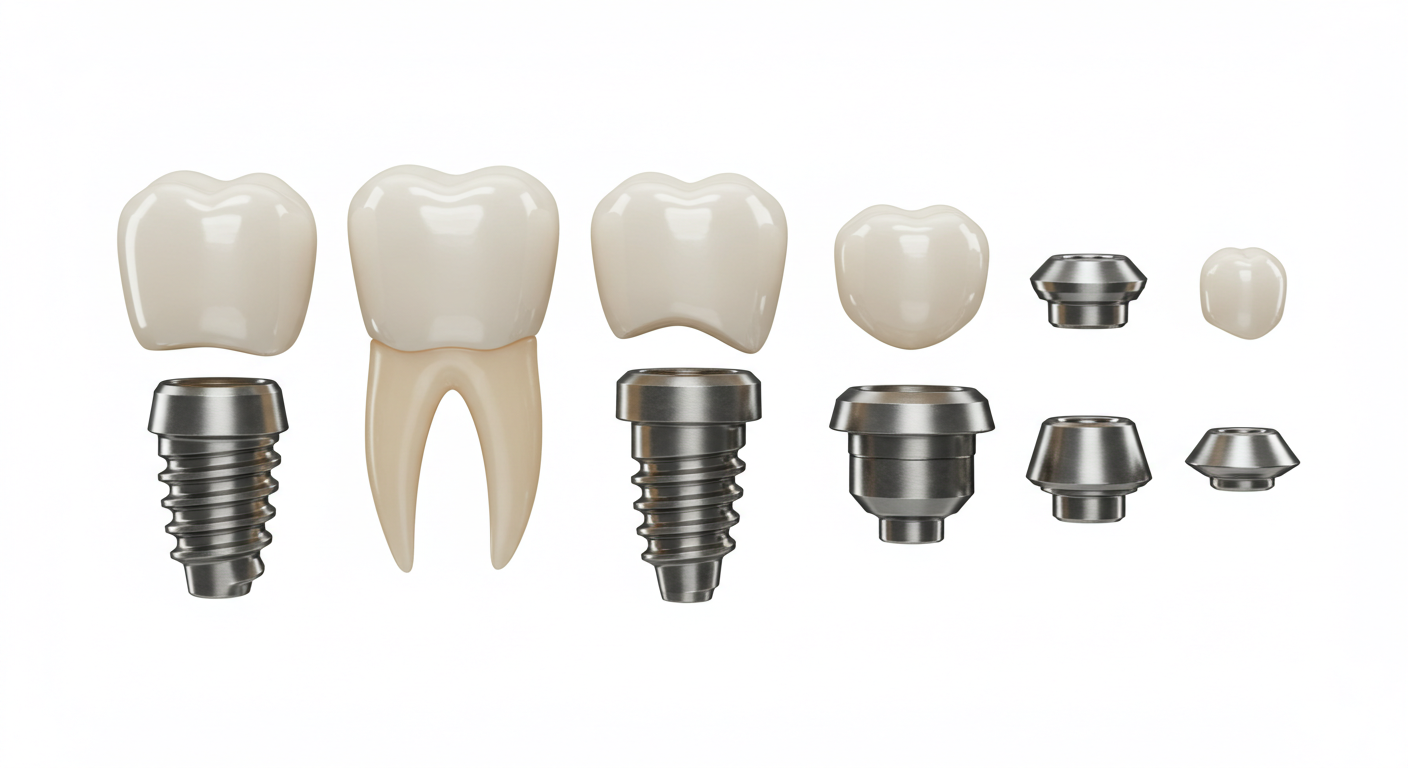
A dental implant is not a single item -- it is a multi-component system installed across several appointments. Understanding each component helps you evaluate quotes and compare pricing between providers. For a complete overview of implant types and the procedure itself, see our dental implants guide.
| Component | What It Is | National (2026) | NYC (2026) |
|---|---|---|---|
| Consultation + CBCT scan | 3D imaging and treatment plan | $150-$500 | $250-$600 |
| Tooth extraction (if needed) | Simple or surgical extraction | $150-$650 | $200-$800 |
| Bone graft (if needed) | Socket preservation or ridge augmentation | $500-$2,500 | $800-$3,000 |
| Sinus lift (if needed) | Adds bone height in upper jaw | $1,500-$3,000 | $2,000-$4,000 |
| Implant body (surgery) | Titanium/zirconia post placed in bone | $1,500-$3,000 | $2,000-$3,500 |
| Abutment | Connector between implant and crown | $300-$700 | $500-$1,000 |
| Implant crown | Custom zirconia or ceramic crown | $1,000-$2,000 | $1,500-$2,500 |
| Temporary tooth (during healing) | Flipper, Maryland bridge, or temp crown | $200-$800 | $300-$1,000 |
Typical total for a straightforward single implant (no bone graft): $3,000-$6,500 in NYC. With bone grafting: $4,000-$9,000. These ranges reflect the variability across Manhattan, Brooklyn, Queens, the Bronx, and Staten Island -- and even within the same borough, pricing can vary by 30-50% between practices.
Multi-Tooth and Full-Arch Implant Costs
Replacing multiple teeth with implants does not scale linearly -- strategic implant placement can support bridges that span several teeth, reducing per-tooth cost.
| Scenario | Implants Needed | NYC Cost Range (2026) | Per-Tooth Cost |
|---|---|---|---|
| Single missing tooth | 1 implant | $3,000-$6,500 | $3,000-$6,500 |
| 3 adjacent missing teeth | 2 implants + 3-unit bridge | $6,000-$15,000 | $2,000-$5,000 |
| Full arch (All-on-4) | 4 implants + fixed prosthesis | $20,000-$35,000 | $1,400-$2,500 |
| Full arch (All-on-6, zirconia) | 6 implants + zirconia prosthesis | $30,000-$45,000 | $2,100-$3,200 |
| Both arches (upper + lower) | 8-12 implants total | $40,000-$90,000 | $1,400-$3,200 |
"For patients missing all their teeth, the All-on-4 concept delivers the most dramatic quality-of-life improvement per dollar spent in all of dentistry. You go from loose, uncomfortable dentures to fixed, permanent teeth that look and function naturally -- often in a single day for the provisional restoration."
Why Implant Prices Vary So Much in NYC
Patients are often confused by the wide range of quotes they receive when consulting multiple providers. Several factors explain the variation:
Implant brand: Premium systems like Nobel Biocare and Straumann cost the dentist $300-$500 per implant body, while generic or lesser-known systems may cost $100-$200. The premium brands offer extensive clinical research, superior surface technology, and a global parts supply chain that ensures replacement components are available decades from now. Surgeon expertise: Board-certified oral surgeons and periodontists with implant fellowships typically charge more than general dentists who place implants as one of many services. Their higher fees reflect years of additional training and experience handling complications. Technology: Practices with guided surgery protocols, CBCT scanners, and digital workflows invest heavily in equipment that improves precision but adds to overhead.
Location within NYC: Manhattan offices -- particularly in Midtown, the Upper East Side, and the Financial District -- have the highest overhead costs in the country. Brooklyn (Park Slope, Brooklyn Heights, Williamsburg) and Queens (Astoria, Flushing, Forest Hills) practices typically offer 15-30% lower fees. The Bronx and Staten Island tend to have the most competitive pricing in the five boroughs.
Included services: Always request an itemized treatment plan. Some quotes bundle everything (consultation, imaging, surgery, bone graft, abutment, crown) into one price, while others quote only the implant placement fee and add components separately. A $1,500 "implant special" that excludes the abutment, crown, and bone graft will ultimately cost just as much as a $4,500 all-inclusive quote.
Warning: Be skeptical of implant advertisements offering prices below $1,000 per implant in NYC. These often use bait-and-switch tactics, quoting only the surgical placement fee while excluding the abutment ($500-$1,000), crown ($1,500-$2,500), bone graft ($800-$3,000), and imaging ($250-$600). Always get a written total treatment estimate before committing.
Insurance Coverage for Dental Implants
Insurance coverage for dental implants has improved significantly over the past five years, but it remains inconsistent. Here is how different plan types handle implant coverage in 2026:
Dental PPO plans: Approximately 40% of dental PPO plans now include implant coverage, typically at 50% of the allowed amount after your deductible. However, annual maximums of $1,500-$2,500 severely limit the benefit. For a $5,000 implant, your plan might pay $1,250-$2,500, leaving you with $2,500-$3,750 out of pocket. Some premium plans have increased annual maximums to $3,000-$5,000, which provides more meaningful coverage.
Dental HMO/DHMO plans: These typically offer fixed copays for implants, often $1,000-$2,500 per implant, but you must use an in-network provider. Medical insurance: If tooth loss resulted from trauma (accident, assault), cancer treatment (radiation-induced tooth loss), or a congenital condition, your medical insurance may cover some or all of the implant cost. This is especially relevant for patients whose tooth loss is related to a medical diagnosis.
Strategies to Maximize Insurance Benefits
Smart Insurance Strategies for Implant Patients
- • Split treatment across calendar years: Get the surgical placement in December and the crown in January to use two years of benefits
- • Coordinate dental + medical insurance: Submit the surgical component to medical insurance if tooth loss was trauma-related
- • Use "alternate benefit" clauses: Even if your plan does not cover implants, it may pay the equivalent cost of a covered alternative (bridge) toward your implant
- • Pre-authorize every component separately: Implant body, abutment, crown, and bone graft often have different CDT codes with separate coverage
- • Consider upgrading your plan: If your employer offers plan choices during open enrollment, compare implant coverage across options before your treatment year
FSA and HSA: The Tax Advantage
Using pre-tax dollars through an FSA or HSA is one of the most effective ways to reduce your implant cost. Both account types classify dental implants as qualified medical expenses, including all components: consultation, imaging, bone graft, implant surgery, abutment, and crown.
FSA (Flexible Spending Account): Allows you to set aside up to $3,200 per year (2026 limit) in pre-tax dollars. The key limitation is the "use it or lose it" rule -- funds must be spent within the plan year (or a short grace period). If your implant treatment spans two plan years, estimate your costs carefully. Some employers offer a $640 carryover. HSA (Health Savings Account): Available only with high-deductible health plans, HSAs have higher contribution limits ($4,300 individual / $8,550 family in 2026) and no expiration -- funds roll over indefinitely and grow tax-free. For a $5,000 implant, using HSA funds saves $1,000-$1,750 depending on your marginal tax rate (federal + state + FICA).
Financing and Payment Plans
Many NYC implant practices offer financing to make treatment accessible. Common options include:
CareCredit: The most widely accepted dental financing option, offering 0% APR promotional periods of 6, 12, 18, or 24 months. Monthly payments on a $5,000 implant at 0% for 24 months would be approximately $209/month. Lending Club: Offers fixed-rate loans with terms of 24-84 months and APRs from 7.99% to 24.99% based on creditworthiness. In-house payment plans: Many practices offer interest-free splits of 3-12 months without a credit check. Dental discount plans: Not insurance, but membership programs that offer 15-30% off retail fees at participating practices. Annual membership costs $100-$200.
"When patients tell me they cannot afford an implant, I walk them through the math: insurance covers $1,500, FSA saves another $1,000 in taxes, and CareCredit spreads the remaining $2,500 over 24 months at 0% interest. Suddenly a $5,000 procedure becomes $104 per month -- and it lasts a lifetime."
Implants vs Alternatives: Long-Term Cost Comparison
While implants have the highest upfront cost, their long-term value often makes them the most cost-effective option over a lifetime. Here is how the math works over 25 years:
| Option | Initial NYC Cost | Replacements Over 25 Years | 25-Year Total Cost |
|---|---|---|---|
| Dental implant | $4,500 | 1 crown replacement ($2,000) | $6,500 |
| Dental bridge | $3,500 | 1-2 replacements ($3,500-$7,000) | $7,000-$10,500 |
| Partial denture | $1,500 | 3-4 replacements + relines ($4,500-$6,000) | $6,000-$7,500 |
| No replacement (do nothing) | $0 | Bone loss, shifting teeth, potential future work | $3,000-$10,000+ |
The "do nothing" option is deceptively expensive. When a tooth is lost and not replaced, adjacent teeth shift, the opposing tooth over-erupts, bone is lost, and bite problems develop -- all of which can require orthodontic treatment, additional crowns, or more complex restorations down the road. Many patients who delay implants eventually spend more correcting secondary problems than the implant would have cost originally.
Warning: Do not travel abroad for dental implants without careful research. "Dental tourism" packages offering implants for $800-$1,500 may seem attractive, but complications requiring revision surgery in NYC can cost more than having the implant placed locally. Follow-up care spanning 3-6 months is also impractical when the surgeon is overseas. If you do pursue treatment abroad, verify the implant brand, request all records, and ensure a local NYC dentist is willing to manage your follow-up care.
Frequently Asked Questions
A single dental implant in New York City costs $3,000 to $6,500 in 2026 for the complete restoration (implant body + abutment + crown). Manhattan practices tend to charge at the higher end ($4,500-$6,500), while Brooklyn and Queens offices often range from $3,000 to $5,000. These prices do not include bone grafting ($800-$3,000), which approximately 40-50% of patients require.
Dental implant costs reflect several factors: the implant itself is a precision-engineered titanium or zirconia device (manufacturer cost $200-$500); the surgical procedure requires advanced training, 3D imaging, and sterile surgical protocols; the crown is custom-fabricated by a dental laboratory; and the entire process spans 3-6 months of professional oversight. In NYC, higher office overhead, staff costs, and lab fees add 15-25% to national averages.
Approximately 40% of dental PPO plans now offer some coverage for implants, typically paying 50% of the allowed amount up to the plan's annual maximum ($1,500-$2,500). Some plans classify implants under major restorative care, while others still exclude them entirely. Medical insurance may cover implants if tooth loss resulted from trauma, cancer treatment, or a congenital condition. Always request pre-authorization before scheduling surgery.
Not necessarily, but extreme discounts warrant caution. Reputable implant systems (Nobel Biocare, Straumann, Zimmer Biomet) have decades of published clinical data supporting their long-term success. Off-brand or generic implant systems may lack this evidence base. Low prices may also reflect less experienced surgeons, absence of 3D planning, or bundled pricing that excludes necessary components. Ask for an itemized estimate and verify the implant brand being used.
Yes, dental implants are a qualified medical expense under both FSA and HSA plans. Using pre-tax dollars effectively reduces your cost by 20-35% depending on your tax bracket. For a $5,000 implant, that means $1,000-$1,750 in tax savings. FSA funds must be used within the plan year (or grace period), so coordinate your implant timeline accordingly. HSA funds roll over indefinitely, offering more flexibility.
Sources
1. American Academy of Implant Dentistry, "Dental Implant Cost Guide," AAID, 2025.
2. American Dental Association, "Survey of Dental Fees," ADA Health Policy Institute, 2025.
3. National Association of Dental Plans, "Implant Coverage Trends in Employer-Sponsored Plans," NADP, 2025.
4. IRS Publication 502, "Medical and Dental Expenses (Including HSA and FSA Rules)," Internal Revenue Service, 2026.
5. Zygogiannis K, Toma S, Al Asfour A, "Cost-effectiveness analysis of dental implants versus fixed dental prostheses," Clinical Oral Implants Research, 2023.
6. Nobel Biocare, "Product Catalog and Suggested Retail Pricing," Nobel Biocare USA, 2026.
7. Straumann Group, "Implant Systems Comparison Guide," Straumann, 2025.
8. U.S. Bureau of Labor Statistics, "Consumer Price Index -- Dental Services, New York Metro Area," BLS, 2025-2026.
9. CareCredit, "Dental Financing Terms and Promotional Offers," Synchrony Financial, 2026.
Get a Free Implant Consultation in NYC
Many top NYC implant providers offer complimentary or low-cost initial consultations with 3D imaging. Find one near you today.
Find a Provider in NYC