Getting Straight Teeth in 2026: Invisalign, Braces & Every Option Compared
Approximately 4 million Americans are in active orthodontic treatment at any given time, and one in three of them is an adult. The desire for straight teeth is not just cosmetic -- misaligned teeth are harder to clean, contribute to gum disease, cause uneven wear, and can trigger jaw pain that radiates into chronic headaches. In New York City, where appearance and health intersect with professional demands, the decision to straighten your teeth is both a medical and a quality-of-life investment.
This 2026 guide covers every current option for getting straight teeth -- from traditional metal braces to Invisalign clear aligners to lingual braces -- with honest comparisons of effectiveness, timelines, comfort, and costs specific to NYC.
Teeth Straightening at a Glance (2026)
- • Treatment time: 3-6 months (minor cases) to 18-30 months (complex cases)
- • Main options: Metal braces, ceramic braces, lingual braces, Invisalign
- • NYC costs: $5,000-$13,000 depending on treatment type and borough
- • Best for adults: Invisalign (most popular) or lingual braces (most invisible)
- • Visible results: Most patients notice improvement within 2-3 months
- • No shortcuts: Only professional orthodontic appliances can safely move teeth
Why Teeth Become Crooked: Understanding the Problem
Before exploring solutions, it helps to understand why teeth end up misaligned in the first place. Malocclusion (the clinical term for crooked teeth and bite problems) affects an estimated 56% of the US population to some degree, according to data from the National Institute of Dental and Craniofacial Research. The causes fall into two categories: genetic and environmental.
Genetic Factors
The size and shape of your jaw and teeth are largely inherited. When you inherit a small jaw from one parent and large teeth from another, there simply is not enough room for all 32 adult teeth to align properly. This is the most common cause of crowding and is why crooked teeth often run in families.
Jaw growth patterns are also genetic. An underdeveloped lower jaw leads to an overbite; an overgrown lower jaw creates an underbite. These skeletal issues affect both function and appearance and are best treated during adolescence when jaw growth can be guided, though adult correction is possible through orthodontics and, in severe cases, orthognathic surgery.
Environmental and Behavioral Factors
- Childhood habits: Prolonged thumb sucking or pacifier use beyond age 3-4 can push front teeth forward and narrow the upper arch.
- Premature tooth loss: When a baby tooth is lost too early (from decay or trauma), adjacent teeth drift into the gap, blocking the permanent tooth from erupting properly.
- Mouth breathing: Chronic mouth breathing during childhood alters jaw development and tongue posture, leading to a long, narrow face and crowded teeth.
- Tooth loss in adulthood: A missing tooth causes neighboring teeth to tilt and shift over months and years.
- Wisdom teeth: While debated, impacted third molars can contribute to crowding, particularly in the lower front teeth.
- Trauma: A blow to the face during childhood can damage developing tooth buds or shift existing teeth.
"Most patients think crooked teeth are purely cosmetic, but misalignment has real functional consequences. Crowded teeth trap plaque in areas a toothbrush cannot reach, leading to cavities and periodontal disease. Bite problems cause asymmetric forces that wear down enamel and stress the TMJ."
Every Option for Straightening Teeth in 2026
Modern orthodontics offers more choices than ever, each with distinct advantages and trade-offs. The right option depends on your clinical needs, lifestyle, budget, and aesthetic priorities. Here is a thorough comparison.
Traditional Metal Braces
Metal braces remain the workhorse of orthodontics and the most versatile treatment for complex cases. Stainless steel brackets are bonded to each tooth and connected by an archwire that applies continuous pressure. Modern brackets are significantly smaller and more comfortable than those from even a decade ago.
Best for: Severe crowding, complex bite correction (deep overbite, crossbite, open bite), large tooth rotations, cases requiring vertical tooth movement, and patients who prefer a "set it and forget it" approach with no compliance requirements.
Drawbacks: Visible metal on teeth; dietary restrictions (no popcorn, hard candy, sticky foods); harder to brush and floss around; monthly adjustment appointments.
Ceramic (Clear) Braces
Ceramic braces work identically to metal braces but use tooth-colored or clear brackets that blend with your enamel. The archwire can also be coated in white for additional discretion. They are a popular compromise for patients who need the effectiveness of braces but want a less noticeable appearance.
Best for: Teens and adults who need braces-level correction but are self-conscious about metal; moderate to severe cases.
Drawbacks: Ceramic brackets are slightly larger and more fragile than metal; they can stain if you consume coffee, wine, or curry; treatment cost is $1,000-$1,500 more than metal braces.
Lingual Braces
Lingual braces are bonded to the back (tongue side) of your teeth, making them completely invisible from the outside. They are custom-fabricated using digital scans and offer the same biomechanical capabilities as traditional braces.
Best for: Adults who require braces-level correction but absolutely cannot have visible appliances (actors, models, public speakers, executives).
Drawbacks: Highest cost of any orthodontic option ($9,000-$13,000 in NYC); initial tongue irritation and speech adjustment (1-3 weeks); fewer orthodontists are trained in this technique; longer appointment times.
Invisalign Clear Aligners
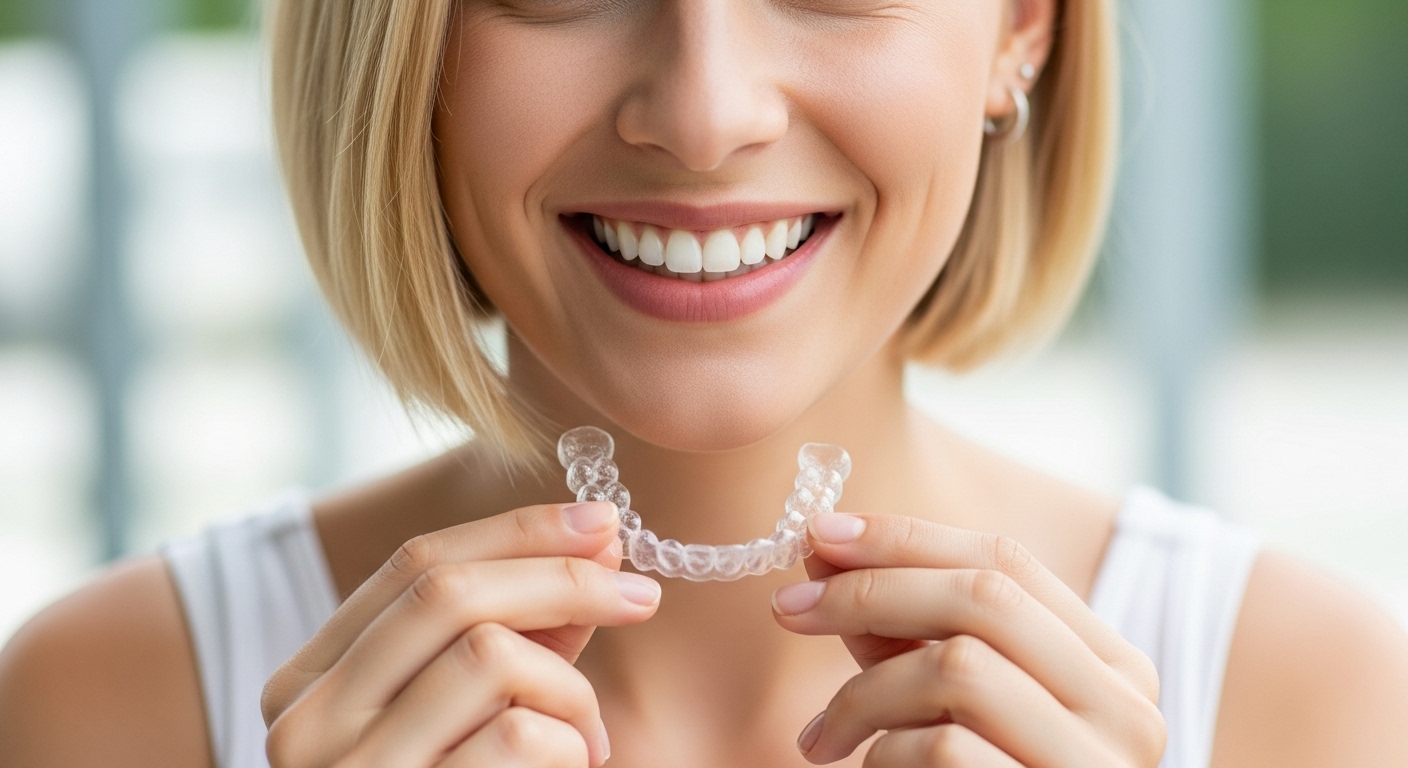
Invisalign uses a series of custom-made, clear plastic trays (aligners) that gradually shift teeth into position. Each set of aligners is worn for 1-2 weeks before advancing to the next. The aligners are removable for eating and brushing, and they are nearly invisible when worn.
Best for: Adults and professionals with mild to moderate crowding, gaps, and many bite issues who value discretion and lifestyle flexibility.
Drawbacks: Requires 20-22 hours daily wear (patient compliance is critical); less effective for severe cases; aligners must be removed for all eating and drinking (except water); treatment success depends heavily on patient discipline.
Side-by-Side Treatment Comparison
| Factor | Metal Braces | Ceramic Braces | Lingual Braces | Invisalign |
|---|---|---|---|---|
| Visibility | Visible | Semi-discreet | Invisible | Nearly invisible |
| NYC Cost | $5,000-$8,500 | $6,000-$9,500 | $9,000-$13,000 | $5,500-$9,500 |
| Treatment Duration | 12-24 months | 12-24 months | 12-24 months | 6-18 months |
| Food Restrictions | Yes (hard, sticky foods) | Yes (hard, sticky, staining) | Yes (hard, sticky foods) | None (remove to eat) |
| Compliance Required | None (fixed) | None (fixed) | None (fixed) | High (22 hrs/day) |
| Case Complexity | All cases | Moderate to severe | Moderate to severe | Mild to moderate |
| Office Visits | Every 4-6 weeks | Every 4-6 weeks | Every 4-6 weeks | Every 6-10 weeks |
For a more detailed head-to-head analysis, see our Invisalign vs. braces comparison and our breakdown of Invisalign pros and cons.
How Long Does It Actually Take?
One of the first questions every patient asks is how long treatment will take. The honest answer depends on the severity of your case, the treatment method, your age, and your compliance. Here are realistic timelines based on published clinical data and common NYC practice experience.
| Case Type | Invisalign | Braces | When Results Show |
|---|---|---|---|
| Minor (small gap, slight crowding) | 3-6 months | 6-9 months | 4-6 weeks |
| Moderate (crowding, spacing, mild bite issues) | 9-18 months | 12-18 months | 2-3 months |
| Complex (severe crowding, bite correction) | 18-24 months (if eligible) | 18-30 months | 3-4 months |
| Surgical cases (skeletal discrepancy) | N/A (braces required) | 24-36 months total | After surgical phase |
For a detailed week-by-week breakdown of the Invisalign experience, read our Invisalign treatment timeline guide.
Warning: Be skeptical of any provider who guarantees extremely fast results. Claims of "straight teeth in 6 weeks" are a red flag. Biological tooth movement through bone takes time -- teeth typically move 0.5-1.0 mm per month. Attempting to move teeth faster risks root resorption (permanent root shortening), bone loss, and relapse.
What Teeth Straightening Costs in NYC (2026)
Orthodontic costs in New York City run 20-40% higher than the national average, reflecting the city's elevated rent, labor, and operating expenses. However, outer-borough practices offer prices much closer to national norms. Here is the full picture.
Cost by Treatment Type
- Metal braces: $5,000-$8,500 (most affordable for comprehensive treatment)
- Ceramic braces: $6,000-$9,500 (aesthetic upgrade over metal)
- Invisalign Comprehensive: $5,500-$9,500 (includes unlimited refinements at most practices)
- Invisalign Lite/Express: $3,000-$5,000 (for minor cases only)
- Lingual braces: $9,000-$13,000 (custom fabrication drives the premium)
For a complete cost analysis including insurance strategies, read our Invisalign cost and insurance guide.
How to Reduce Your Out-of-Pocket Cost
- Dental insurance: Most PPO plans with orthodontic benefits cover $1,500-$3,000. Some plans cover both adult and child orthodontics; others limit coverage to patients under 19.
- FSA/HSA: Pre-tax payroll dollars can be used for orthodontic fees, effectively saving 20-30% depending on your marginal tax rate. In high-tax New York, this savings is substantial.
- In-house financing: The majority of NYC orthodontists offer 0% interest payment plans over 12-24 months. Typical down payment is $500-$1,500 with monthly payments of $150-$350.
- Multi-child discounts: Many practices offer 5-10% discounts for families treating multiple members.
- Tax deductions: Orthodontic expenses exceeding 7.5% of your adjusted gross income may be deductible on federal taxes (consult your tax professional).
"Cost should be a factor in your decision, but do not make it the only factor. A lower fee does not always mean a better deal -- it may mean fewer included services, less experienced providers, or corner-cutting on materials. Always ask what is included in the quoted price."
Getting Straight Teeth as an Adult in NYC
If you are an adult considering orthodontic treatment, you are far from alone. The AAO reports that approximately 27% of orthodontic patients nationwide are adults, and that percentage is higher in urban markets like New York. Several factors are driving this trend:
- Invisible options: Invisalign and lingual braces have eliminated the stigma of "adult braces." Many patients complete treatment without colleagues or casual acquaintances ever noticing.
- Professional motivation: In New York's competitive job market, a confident smile matters in meetings, presentations, and client-facing roles. Studies consistently link smiling with perceived competence and trustworthiness.
- Health awareness: Adults increasingly understand that crowded teeth contribute to gum disease and tooth loss over time. Straightening teeth is preventive dental care, not vanity.
- Technology improvements: Treatment is faster, more comfortable, and more predictable than it was 10 years ago. Digital planning with ClinCheck means fewer surprises.
For a complete guide to adult treatment options, read our Invisalign for adults resource. If your primary concern is crooked teeth or gaps between teeth, those dedicated guides go deeper into specific conditions.
Adult Treatment: What to Know
- • Adult teeth move slightly slower than adolescent teeth, but outcomes are equivalent
- • Bone density in adults is higher, which means teeth hold position well after treatment
- • Existing dental work (crowns, bridges, implants) requires careful planning but does not disqualify you
- • Periodontal health must be stable before starting -- gum disease needs treatment first
Can You Straighten Teeth Without Orthodontic Treatment?
No. This is one of the most important misconceptions to address directly. Teeth are embedded in bone and held in place by periodontal ligaments. Moving them safely requires controlled, sustained biomechanical force applied by professionally designed appliances -- either brackets and wires (braces) or custom-engineered thermoplastic trays (Invisalign).
There are no "natural" methods for straightening teeth. Specifically:
- Mewing: Tongue posture exercises popularized on social media. While proper tongue posture is generally healthy, no peer-reviewed evidence supports mewing as a teeth-straightening method in adults.
- Rubber bands or DIY aligners: Extremely dangerous. Uncontrolled forces can cause tooth loss, root resorption, and permanent bone damage. The FDA has issued warnings against DIY orthodontics.
- Dental veneers or bonding: These cosmetic procedures can create the illusion of straight teeth by changing the surface shape, but they do not move teeth. They also require removing healthy enamel and replacing it with artificial material.
Warning: Mail-order aligner companies that skip in-person orthodontic supervision have faced lawsuits, FDA complaints, and state dental board actions. While the concept of remote monitoring is evolving, the AAO strongly recommends in-person examination and oversight by a licensed orthodontist for any tooth-moving treatment.
After Treatment: Why Retainers Are Non-Negotiable
Every orthodontic treatment -- whether braces or Invisalign -- must be followed by retainer wear to prevent teeth from shifting back toward their original positions. This is not optional. Teeth have "memory" in the form of elastic fibers in the periodontal ligament that pull them back toward their pre-treatment positions, especially in the first 12-18 months after active treatment ends.
Most orthodontists prescribe one of two retention strategies:
- Removable retainers: Clear plastic trays (similar to Invisalign aligners) worn nightly for life. The current consensus is that permanent retention is necessary -- not just "a few years."
- Fixed retainers: A thin wire bonded to the back of the lower front teeth (and sometimes upper). Provides passive retention 24/7 with no compliance requirement. Most effective for lower front teeth, which are the most prone to relapse.
Many orthodontists recommend a combination: a fixed retainer on the lower teeth plus a removable retainer for nightly wear on the upper teeth. For more on this critical phase, see our Invisalign retainers guide.
How to Choose the Right Provider in NYC
The quality of your results depends heavily on who performs your treatment. An orthodontist with excellent credentials, modern technology, and a patient-centered approach will produce better outcomes than a less experienced provider, regardless of the treatment method used.
Key factors to evaluate:
- Specialty training: Always choose a board-certified orthodontist (not a general dentist offering aligners) for anything beyond the most minor cosmetic alignment.
- Experience with your condition: Ask to see before-and-after cases similar to yours.
- Technology: 3D digital scanners, CBCT imaging, and digital treatment planning are standard at top NYC practices in 2026.
- Transparent pricing: Get a written fee estimate that specifies what is included (retainers, refinements, emergency visits).
- Consultation quality: The orthodontist should spend time explaining your diagnosis, showing imaging, and discussing options -- not just pushing the most expensive treatment.
For a comprehensive checklist, see our guide to finding the best orthodontist in NYC.
Frequently Asked Questions
Treatment duration depends on your specific case. Minor crowding or small gaps can be corrected in 3-6 months with Invisalign Express. Moderate alignment issues typically take 12-18 months. Severe malocclusion with complex bite correction may require 18-30 months. Most patients see visible improvement within the first 2-3 months regardless of method.
There is no upper age limit for orthodontic treatment. As long as your teeth and supporting bone are healthy, you are a candidate. About 27% of US orthodontic patients are adults, and in NYC that percentage is even higher. Many patients in their 40s, 50s, and 60s complete treatment successfully.
For mild to moderate crowding, gaps, and many bite issues, Invisalign is equally effective. Published studies show comparable outcomes for these cases. However, severe skeletal discrepancies, complex tooth rotations exceeding 20 degrees, and significant vertical movement are still better addressed with traditional braces.
No. Controlled, sustained force is the only way to safely move teeth through bone. There are no exercises, mewing techniques, rubber bands, or DIY products that can straighten teeth. Veneers can create the appearance of straighter teeth but do not actually move them and require removing healthy tooth structure.
Traditional metal braces are typically the most affordable option at $5,000-$8,500 in NYC. Invisalign Express or Lite for minor cases can cost $3,000-$5,000. Insurance covers $1,500-$3,000 of treatment, and most orthodontists offer 0% financing over 12-24 months. FSA and HSA pre-tax dollars can reduce your effective cost by 20-30%.
Sources
1. American Association of Orthodontists (AAO) — Economics of Orthodontics Annual Survey, 2025
2. National Institute of Dental and Craniofacial Research (NIDCR) — Prevalence of Malocclusion in the United States, 2024
3. American Journal of Orthodontics and Dentofacial Orthopedics — "Comparative Effectiveness of Clear Aligners vs. Fixed Appliances," 2024
4. Journal of Clinical Orthodontics — "Long-Term Stability and Retention Protocols After Orthodontic Treatment," 2023
5. Align Technology — Invisalign Clinical Guidelines and Case Selection Criteria, 2025
6. FDA — Consumer Alert on DIY Orthodontic Products, 2023
7. American Board of Orthodontics (ABO) — Certification Requirements and Statistics, 2025
8. Journal of Dental Research — "Orthodontic Treatment Outcomes in Adult vs. Adolescent Patients: A Systematic Review," 2024
Conclusion
Getting straight teeth in 2026 is more accessible, more comfortable, and more discreet than at any point in orthodontic history. Whether you choose traditional braces for complex correction or Invisalign for a nearly invisible experience, the technology and clinical expertise available in New York City are world-class.
The single most important decision is not which treatment you pick -- it is who performs it. A skilled, board-certified orthodontist will recommend the right approach for your specific anatomy, lifestyle, and goals. Start with a consultation (most are free in NYC), ask the right questions, and invest in a provider who puts your clinical outcome first.
Ready to Get the Straight Smile You Deserve?
Find a board-certified orthodontist in NYC for a free consultation and personalized treatment plan.
Find a Provider in NYC