Dental Insurance PPO vs HMO: Which Plan Is Better? (2026 NYC Comparison)
Choosing the right dental insurance plan is one of the most impactful financial decisions you can make for your oral health -- especially in New York City, where dental costs run 15-25% above the national average. A single root canal and crown can cost $3,000-$4,500 in Manhattan, making insurance coverage not just nice to have but financially critical. This 2026 guide compares PPO and HMO dental plans head-to-head, with NYC-specific data on costs, provider networks, and real-world scenarios to help you make the right choice.
Quick Comparison: PPO vs HMO Dental Plans (2026)
- • PPO premiums: $30-$70/month (individual) vs HMO: $8-$25/month
- • PPO provider choice: Any dentist (in-network or out) vs HMO: In-network only
- • PPO annual maximum: $1,000-$2,500 vs HMO: No annual maximum
- • PPO referrals: Not required vs HMO: Required for specialists
- • Best for: PPO for flexibility and complex treatment; HMO for low-cost preventive care
How Dental Insurance Works in 2026
Unlike medical insurance, dental insurance operates more like a discount program with defined annual limits. Understanding this fundamental difference is key to choosing the right plan. Most dental plans -- whether PPO or HMO -- categorize services into tiers:
- Preventive (covered at 100%): Routine exams, cleanings (prophylaxis), X-rays, fluoride treatments
- Basic (covered at 70-80%): Fillings, simple extractions, periodontal scaling
- Major (covered at 50%): Crowns, bridges, root canals, dentures, implants (if covered)
- Orthodontics (covered at 50%, if included): Braces and Invisalign with a separate lifetime maximum
This structure is known as the 100-80-50 model and applies to most PPO plans. HMO plans work differently, using fixed copay schedules rather than percentage-based coverage.
Dental PPO Plans Explained
PPO stands for Preferred Provider Organization. Dental PPO plans are the most popular type of dental insurance in the United States and offer the greatest flexibility for patients.
How PPO Plans Work
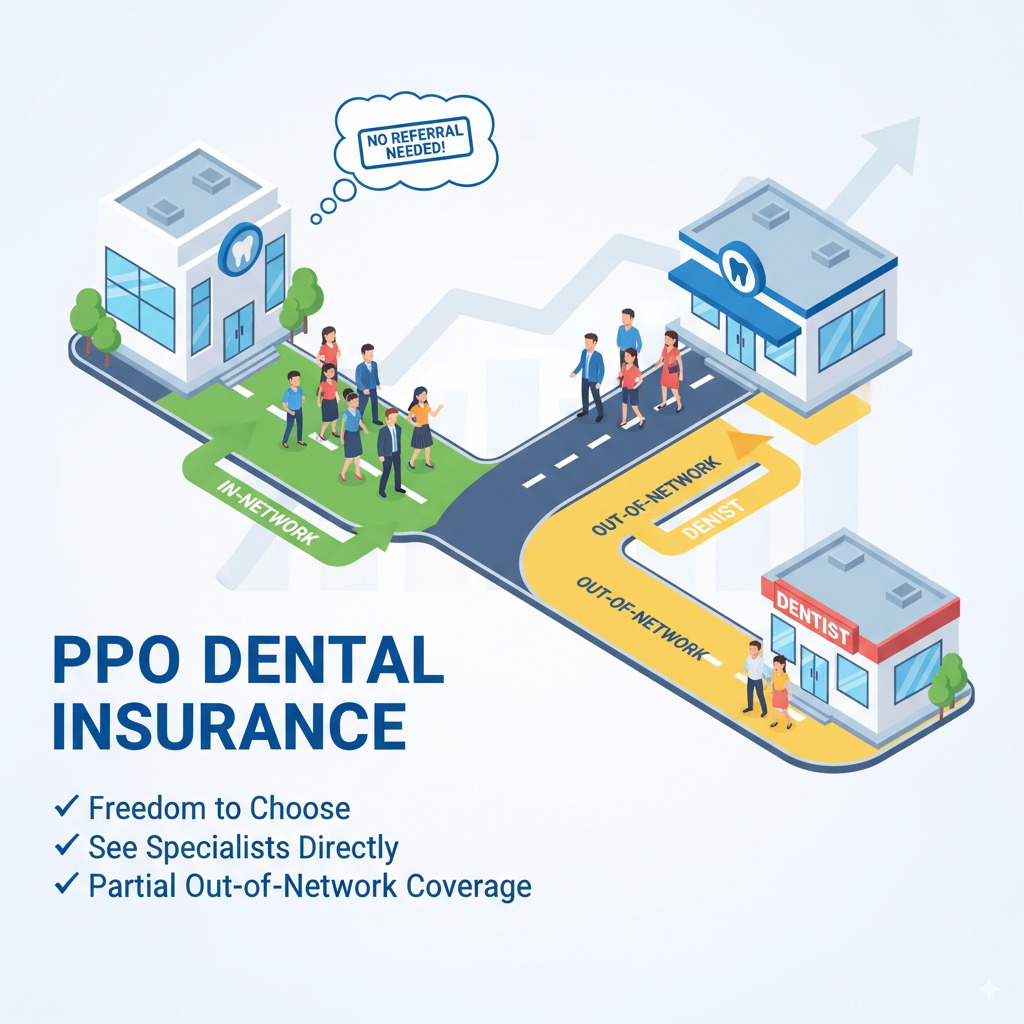
When you have a dental PPO, you can visit any licensed dentist. If you choose an in-network provider -- a dentist who has contracted with your insurance company to accept negotiated rates -- you pay less out of pocket. These negotiated rates are typically 25-40% below the dentist's standard fees. You can also see out-of-network providers, but the plan will reimburse based on a "usual and customary" (UCR) fee schedule, and you are responsible for the difference between that amount and the dentist's actual charge.
PPO Plan Costs in NYC (2026)
- Monthly premium: $30-$70 (individual); $80-$200 (family)
- Annual deductible: $25-$100 per person (preventive care often exempt)
- Annual maximum: $1,000-$2,500 (the most the plan will pay per year)
- Coverage split: 100% preventive / 80% basic / 50% major
- Orthodontic coverage: 50% up to a lifetime maximum of $1,000-$2,500 (if included)
PPO Pros and Cons
Advantages:
- Freedom to see any dentist -- crucial in NYC where you may want access to top specialists
- No referrals needed for specialists (periodontists, endodontists, oral surgeons, orthodontists)
- Out-of-network coverage (partial) -- if your preferred dentist is not in-network, you still get some benefit
- Percentage-based coverage provides transparent cost sharing
- Large provider networks in NYC (most dentists accept major PPO plans)
Disadvantages:
- Higher monthly premiums than HMO plans
- Annual maximum caps total benefits ($1,000-$2,500), which may not cover extensive treatment
- Deductibles must be met before basic and major coverage kicks in
- Out-of-network costs can be significantly higher
Dental HMO (DHMO) Plans Explained
HMO stands for Health Maintenance Organization. Dental HMO plans (sometimes called DHMO or prepaid dental plans) operate differently from PPOs and are the budget-friendly option in the dental insurance market.
How HMO Plans Work
When you enroll in a dental HMO, you choose or are assigned a primary care dentist from the plan's network. All your dental care must go through this dentist, who serves as a gatekeeper. If you need specialist care (oral surgery, periodontics, orthodontics), your primary dentist must provide a referral, and the specialist must be in-network. If you see a provider outside the network, the plan pays nothing.
HMO Plan Costs in NYC (2026)
- Monthly premium: $8-$25 (individual); $25-$75 (family)
- Annual deductible: Usually $0 (no deductible)
- Annual maximum: None (no cap on total benefits per year)
- Coverage structure: Fixed copay schedule (e.g., $0 for cleanings, $25 for fillings, $150 for crowns)
- Orthodontic coverage: Fixed copay, typically $1,500-$2,500 for the full treatment
HMO Pros and Cons
Advantages:
- Much lower monthly premiums -- significant savings for budget-conscious NYC residents
- No annual maximum -- unlimited coverage within the copay structure
- No deductibles -- coverage starts from your first visit
- Predictable costs -- fixed copays make it easy to budget
- No claims to file -- the dentist bills the plan directly
Disadvantages:
- Restricted provider network -- you must use in-network dentists only
- Referrals required for specialists -- adds delays and limits your choices
- Quality concerns -- some HMO-network dentists have high patient volumes
- No out-of-network coverage -- if your preferred dentist is not in-network, you get zero benefit
- Smaller networks in NYC compared to PPO plans
Head-to-Head Comparison: PPO vs HMO
| Feature | Dental PPO | Dental HMO (DHMO) |
|---|---|---|
| Monthly premium (individual) | $30-$70 | $8-$25 |
| Annual deductible | $25-$100 | $0 |
| Annual maximum | $1,000-$2,500 | None (unlimited) |
| Provider choice | Any dentist (in-network or out-of-network) | In-network only |
| Specialist referrals | Not required | Required |
| Out-of-network coverage | Yes (partial reimbursement) | None |
| Coverage structure | Percentage-based (100/80/50) | Fixed copay schedule |
| Waiting periods | 6-12 months for major procedures (some plans) | Usually none or shorter |
| Claims filing | Provider files; out-of-network may require patient filing | No claims to file |
| Best for | Flexibility, specialist access, complex treatment | Budget-conscious, basic/preventive care |
Real-World Cost Scenarios for NYC Patients
Let us compare how PPO and HMO plans perform in three common scenarios for New York City dental patients:
| Scenario | No Insurance | With PPO | With HMO |
|---|---|---|---|
| Preventive only (2 cleanings, exam, X-rays) | $500-$800 | $0 + $480/yr premium = $480 | $0 + $180/yr premium = $180 |
| Moderate treatment (preventive + 2 fillings) | $900-$1,400 | $130-$280 + $480 premium = $610-$760 | $50 copay + $180 premium = $230 |
| Major treatment (preventive + root canal + crown) | $2,800-$4,500 | $1,350-$2,200 + $480 premium = $1,830-$2,680 | $350-$600 copay + $180 premium = $530-$780 |
"I always tell my patients that the best dental insurance plan depends on two things: how much dental work you anticipate needing and how important provider choice is to you. If you have a specific dentist you love who is not in an HMO network, the PPO is worth the premium difference. But if you are healthy and just need cleanings, an HMO can save you hundreds annually."
How to Choose the Right Plan for You
Choose a PPO If You:
- Want the freedom to see any dentist, including out-of-network specialists
- Have a specific dentist you want to continue seeing
- Need or anticipate needing specialist care (periodontist, endodontist, oral surgeon)
- Are undergoing orthodontic treatment and want flexible provider options
- Value convenience over cost -- no referrals, no gatekeepers
- Are willing to pay higher premiums for greater coverage flexibility
Choose an HMO If You:
- Are on a tight budget and need the lowest possible monthly premium
- Primarily need preventive care (cleanings, exams, X-rays)
- Are comfortable with a restricted provider network
- Do not mind getting referrals for specialist visits
- Anticipate needing major work -- HMO's lack of annual maximum can be advantageous
- Are in a family that needs basic coverage for multiple members
Warning: Do not choose a dental plan based solely on the monthly premium. A $10/month HMO plan is only a good deal if you can find quality in-network providers in your NYC neighborhood. Before enrolling, always verify that the plan's provider directory includes dentists near your home or workplace with good reviews and availability. Network directories are sometimes outdated -- call the dental office directly to confirm they currently accept the plan.
FSA and HSA: Tax-Advantaged Dental Savings
Regardless of whether you choose a PPO or HMO, Flexible Spending Accounts (FSAs) and Health Savings Accounts (HSAs) are powerful tools for reducing your dental costs:
- FSA: Available through most employers. Contribute pre-tax dollars (up to $3,200 in 2026) and use them for dental expenses not covered by insurance. Effectively saves 20-35% depending on your tax bracket. Use-it-or-lose-it by year-end (with some exceptions).
- HSA: Available with high-deductible health plans. Contribute pre-tax dollars (up to $4,300 individual / $8,550 family in 2026), and funds roll over year to year. Triple tax advantage: contributions, growth, and qualified withdrawals are all tax-free.
All dental procedures -- from cleanings to dental implants to Invisalign -- are eligible FSA/HSA expenses. For patients facing expensive dental work in NYC, combining insurance with FSA/HSA funds can reduce out-of-pocket costs by 30-50%. Learn more in our dental financing options guide.
Major Dental Insurance Carriers in NYC (2026)
Top Dental Insurance Carriers in NYC
- • Delta Dental: Largest dental network nationwide; strong PPO and HMO options in NYC
- • Cigna Dental: Competitive PPO plans with large NYC network; good orthodontic coverage
- • MetLife Dental: Popular employer-sponsored plans; extensive NYC provider network
- • Aetna Dental: Strong PPO and DHMO options; popular for NYC employer groups
- • Guardian Dental: Good coverage ratios; widely accepted by NYC dentists
- • UnitedHealthcare Dental: Large network; competitive individual and family plans
"The most common mistake I see patients make is choosing the cheapest dental plan without checking the network. In NYC, the difference between a great dental experience and a frustrating one often comes down to having access to the right providers. Spend 15 minutes checking the provider directory before you enroll -- it can save you hours of headaches later."
Orthodontic Insurance Coverage
If you or a family member needs orthodontic treatment, insurance coverage works differently than regular dental benefits:
- PPO orthodontic coverage: Typically 50% up to a lifetime maximum of $1,000-$2,500. Applied to both Invisalign and braces.
- HMO orthodontic coverage: Fixed copay, usually $1,500-$2,500 for the full treatment. No percentage-based coverage.
- Age limits: Some plans only cover orthodontics for children under 19; others cover adults as well
- Waiting periods: 12-24 months is common for orthodontic benefits
For a comprehensive look at orthodontic costs and insurance, see our guides on Invisalign cost and insurance and braces cost.
Frequently Asked Questions
For most NYC patients, a dental PPO offers better value due to greater provider choice, no referral requirements, and out-of-network coverage. NYC has thousands of dental providers, and PPO plans let you see any of them (at higher cost out-of-network). HMOs cost less monthly but restrict you to a smaller network, which can be limiting in NYC where you may want access to specialists. HMOs can be good for basic preventive care on a tight budget.
In NYC in 2026, individual dental PPO premiums range from $30-$70/month ($360-$840/year). Family PPO plans cost $80-$200/month. Individual dental HMO plans cost $8-$25/month ($96-$300/year). Family HMO plans cost $25-$75/month. Employer-sponsored plans are typically 50-80% subsidized. Remember to factor in deductibles, copays, and annual maximums when comparing total cost.
Most dental plans use a 100-80-50 structure: preventive care (cleanings, X-rays, exams) at 100%, basic procedures (fillings, simple extractions) at 80%, and major procedures (crowns, root canals, bridges, implants) at 50%. Some plans cover orthodontics at 50% with a separate lifetime maximum ($1,000-$2,500). Annual maximums typically range from $1,000-$2,500 for PPO plans. HMO plans use fixed copay schedules instead.
Yes, dental PPO plans allow you to see any licensed dentist -- both in-network and out-of-network. However, you will pay significantly less with in-network providers. In-network dentists accept the plan's negotiated fee schedule (usually 25-40% below retail rates), while out-of-network dentists charge their full fee, and you are responsible for the difference. HMO plans restrict you to in-network providers only.
Usually yes, even for preventive care only. Two annual cleanings and an exam in NYC cost $400-$800 out of pocket. An individual PPO plan costs $360-$840/year but covers these services at 100%, plus provides X-rays and discounted rates if you need unexpected treatment. The real value of dental insurance is protection against unexpected costs -- a single root canal and crown can cost $2,000-$4,000 in NYC.
Sources
1. National Association of Dental Plans. 2025 Dental Benefits Report: Enrollment and Design Trends.
2. American Dental Association. Health Policy Institute: Dental Insurance Coverage in America, 2025.
3. New York State Department of Financial Services. Guide to Dental Insurance in New York, 2025.
4. Delta Dental Plans Association. Understanding Your Dental Benefits: PPO vs DHMO, 2025.
5. Internal Revenue Service. Publication 969: Health Savings Accounts and Other Tax-Favored Health Plans, 2025 Tax Year.
6. FAIR Health Consumer Cost Lookup. Dental Procedure Costs by NYC ZIP Code, 2025.
7. Kaiser Family Foundation. Employer Health Benefits Survey, 2025: Dental Coverage Section.
8. New York State Health Insurance Exchange (NY State of Health). 2026 Dental Plan Offerings.
Find Dentists Who Accept Your Insurance in NYC
Whether you have a PPO, HMO, or no insurance at all, connect with quality dental providers across Manhattan, Brooklyn, Queens, and the Bronx.
Find a Provider in NYC