Types of Braces in 2026: Metal, Ceramic, Lingual, Invisalign Compared (NYC Guide)
Orthodontic treatment has come a long way from one-size-fits-all metal brackets. In 2026, New York City patients can choose from at least four distinct categories of braces -- each with different aesthetics, mechanics, price points, and ideal use cases. Whether you are a teenager dreading visible brackets or an adult professional who needs something discreet, understanding the full landscape of options is the first step toward a confident smile. This comprehensive guide compares metal braces, ceramic braces, lingual braces, and Invisalign clear aligners, with NYC-specific pricing and provider insights.
Key Takeaways: Types of Braces in 2026
- • Metal braces: Most affordable ($4,000-$8,500 in NYC), strongest for complex cases
- • Ceramic braces: Tooth-colored brackets, 20-30% more than metal, great for adults
- • Lingual braces: 100% hidden behind teeth, highest cost ($10,000-$14,000 in NYC)
- • Invisalign: Removable clear aligners, ideal for mild to moderate cases ($4,500-$9,000)
- • All four options are widely available across Manhattan, Brooklyn, and Queens
Overview: The Four Main Types of Braces
Before we dive into each option, here is a high-level snapshot. The orthodontic field in 2026 offers more variety than ever, and the "best" choice depends on your clinical needs, aesthetic preferences, budget, and lifestyle. An experienced NYC orthodontist will evaluate your bite, tooth alignment, and jaw relationship before recommending the most effective treatment plan.
| Feature | Metal Braces | Ceramic Braces | Lingual Braces | Invisalign |
|---|---|---|---|---|
| Visibility | Highly visible | Semi-discreet | Invisible (behind teeth) | Nearly invisible |
| NYC Cost Range | $4,000-$8,500 | $5,000-$9,500 | $10,000-$14,000 | $4,500-$9,000 |
| Treatment Time | 18-24 months | 18-26 months | 18-30 months | 12-18 months |
| Best For | Complex cases, all ages | Adults wanting discretion | Total invisibility needs | Mild-moderate cases |
| Comfort Level | Moderate | Moderate | Lower initially | High |
| Removable? | No | No | No | Yes |
Metal Braces: The Gold Standard
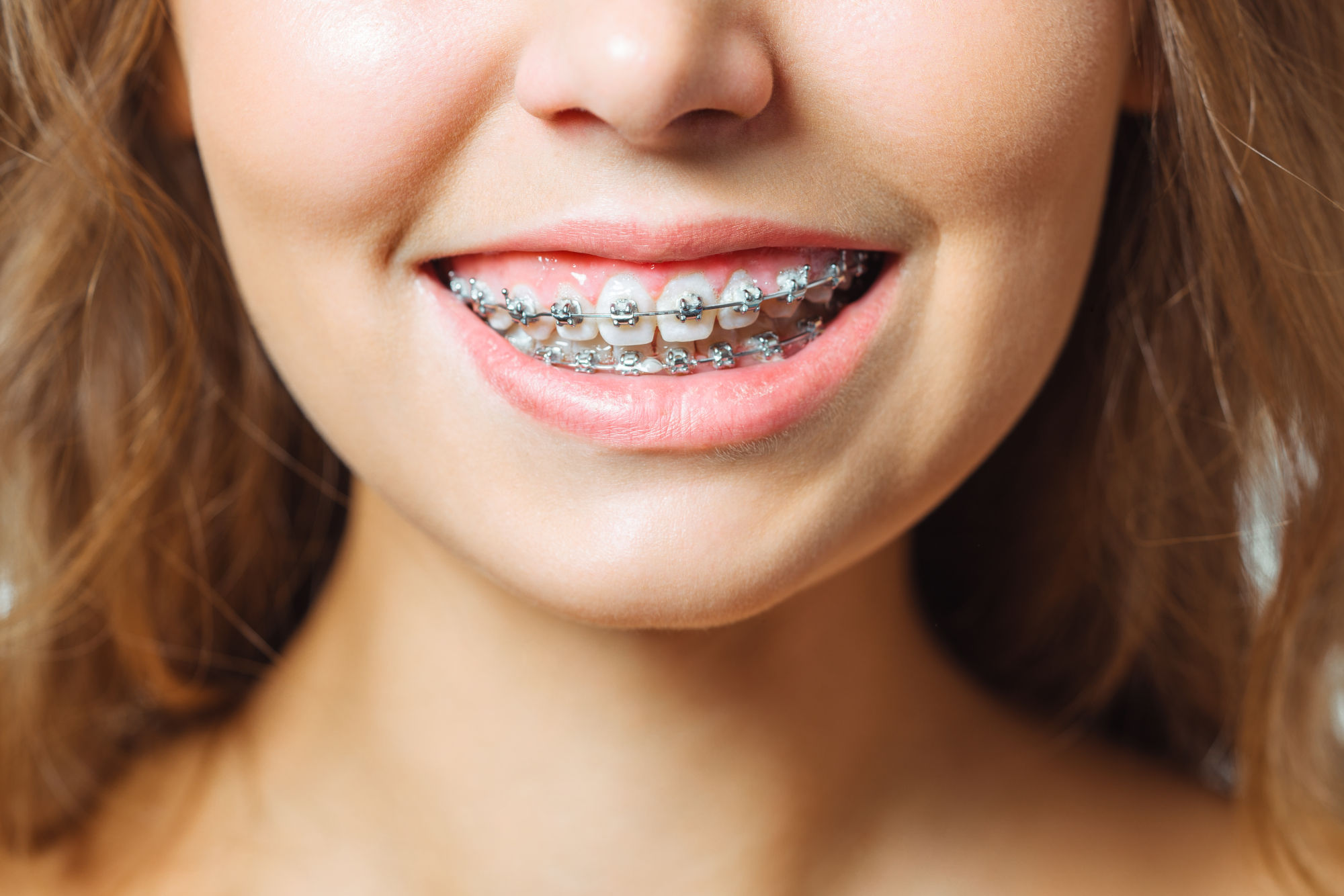
Traditional metal braces remain the most widely used orthodontic appliance worldwide, and for good reason. They consist of stainless-steel brackets bonded to the front surface of each tooth, connected by a metal archwire that the orthodontist adjusts at appointments every 4 to 8 weeks. Modern metal brackets are roughly 40% smaller than those used in the 1990s, and many now feature self-ligating designs (like the Damon System) that reduce friction and may shorten treatment time.
Advantages of Metal Braces
Metal braces excel in versatility. They can treat the full spectrum of orthodontic problems -- from mild crowding to severe malocclusions, impacted teeth, significant bite discrepancies, and cases requiring surgical orthodontics. Because brackets are fixed in place, there is zero reliance on patient compliance for wear time, making them particularly effective for younger patients and teens who might not reliably wear removable aligners 22 hours a day.
They are also the most budget-friendly option. In NYC, traditional metal braces typically range from $4,000 to $8,500, making them $500 to $2,000 less expensive than ceramic or clear aligner alternatives. For families with multiple children needing orthodontics, this price difference can be significant. Many top NYC orthodontists offer interest-free payment plans that break the total into monthly installments of $150 to $300.
Drawbacks of Metal Braces
The most obvious drawback is aesthetics. Metal brackets and wires are clearly visible, which can be a deal-breaker for adult professionals or anyone self-conscious about their appearance during treatment. They also cause more soft-tissue irritation (cheek and lip sores) than other options, particularly in the first few weeks. Dietary restrictions apply: hard, sticky, and crunchy foods can damage brackets or wires. And oral hygiene requires extra effort with interdental brushes and flossers designed for braces.
"Metal braces are still the workhorse of orthodontics. When I have a complex case with severe crowding, deep bite, or impacted canines, fixed metal appliances give me the most precise three-dimensional control over tooth movement."
Ceramic Braces: The Discreet Fixed Option
Ceramic braces function identically to metal braces but use tooth-colored or clear polycrystalline alumina brackets instead of stainless steel. The result is a fixed appliance that blends with the natural tooth color, making it significantly less noticeable from a conversational distance. Many orthodontists also offer tooth-colored or white-coated archwires to further minimize visibility.
Advantages of Ceramic Braces
Ceramic braces offer the full biomechanical control of fixed brackets with substantially better aesthetics. They are an excellent middle ground for patients who need the treatment capabilities of braces but want a less conspicuous appearance. For a detailed breakdown, see our ceramic vs metal braces comparison.
Modern ceramic brackets are more durable than earlier generations and resist staining better than they did even five years ago. They can handle most of the same cases that metal braces treat, including moderate to severe crowding, overbites, underbites, and crossbites. Treatment outcomes are clinically equivalent to metal braces for the vast majority of cases.
Drawbacks of Ceramic Braces
Ceramic brackets are slightly larger and more brittle than metal ones, which means there is a marginally higher risk of bracket breakage. The elastic ties that hold the archwire in place can stain from coffee, tea, curry, and red wine (though these are replaced at each adjustment). Ceramic braces also generate slightly more friction against the archwire, which can extend treatment time by one to three months in some cases. The cost premium over metal braces is typically $1,000 to $2,000 in NYC.
Warning: Ceramic brackets can chip or fracture if you bite into hard foods like apples, nuts, or ice. Always cut hard foods into small pieces and avoid chewing on non-food items like pens or pencils.
Lingual Braces: The Invisible Fixed Option
Lingual braces are fixed brackets and wires placed on the tongue side (lingual surface) of the teeth, making them completely invisible from the outside. Major systems include Incognito (by 3M), WIN, and Harmony. Each bracket is custom-manufactured to fit the unique contour of the tooth's inner surface, using digital impressions and CAD/CAM technology.
Advantages of Lingual Braces
The primary advantage is total invisibility. Unlike clear aligners, lingual braces are fixed and work 24/7 without any compliance requirements. This makes them ideal for professionals, performers, and anyone who absolutely cannot have visible orthodontic hardware but may struggle with aligner compliance. Lingual braces can treat complex cases that clear aligners cannot, including significant bite corrections and difficult tooth movements.
Drawbacks of Lingual Braces
Lingual braces are the most expensive orthodontic option, typically $10,000 to $14,000 in NYC. The learning curve for speech is steeper -- most patients experience a temporary lisp for two to four weeks as the tongue adapts to the brackets. Oral hygiene is more challenging because the brackets are harder to see and access. Treatment time can also be 10-20% longer than labial (front-facing) braces. Fewer orthodontists offer lingual braces because the technique requires specialized training.
"Lingual orthodontics has advanced tremendously with digital workflows. The custom brackets we use today fit more precisely, which means less discomfort and more predictable results than even five years ago. But it remains a specialty within a specialty -- seek an orthodontist with significant lingual experience."
Invisalign Clear Aligners
Invisalign uses a series of custom-fabricated, FDA-cleared thermoplastic aligners that fit snugly over the teeth. Patients switch to a new set of aligners every one to two weeks, with each set making incremental adjustments. The entire treatment is mapped digitally before it begins, and patients can preview their projected outcome in 3D.
Advantages of Invisalign
Invisalign aligners are nearly invisible and completely removable, which means no dietary restrictions and easy oral hygiene. They cause fewer mouth sores and soft-tissue irritation than fixed braces. For mild to moderate cases -- including gaps, mild crowding, and certain bite issues -- Invisalign often achieves results in 12 to 18 months, potentially faster than braces. The technology has improved dramatically: SmartForce attachments and precision cuts now allow Invisalign to treat many cases that were previously limited to braces.
Drawbacks of Invisalign
The system requires strict compliance: aligners must be worn 20 to 22 hours per day to achieve planned results. Patients who frequently forget or remove their aligners will experience delays and compromised outcomes. Invisalign is less effective for severe crowding, complex rotations exceeding 20 degrees, significant vertical movements, and certain skeletal bite problems. For a thorough look at the tradeoffs, read our Invisalign pros and cons guide.
Invisalign vs Braces: Quick Decision Guide
- • Choose Invisalign if you have a mild-moderate case, value aesthetics, and can commit to 22 hr/day wear
- • Choose braces if you have a complex case, want a set-it-and-forget-it system, or need maximum control
- • Read our detailed Invisalign vs braces comparison for more
Cost Comparison: All Braces Types in NYC (2026)
New York City orthodontic fees are among the highest in the country, typically 10-25% above national averages due to elevated overhead costs for office space, staffing, and lab fees. Below is a detailed cost breakdown for each braces type.
| Braces Type | National Average | NYC Average | Monthly Payment* |
|---|---|---|---|
| Metal braces | $3,000-$7,500 | $4,000-$8,500 | $150-$300 |
| Ceramic braces | $4,000-$8,500 | $5,000-$9,500 | $200-$350 |
| Lingual braces | $8,000-$13,000 | $10,000-$14,000 | $350-$550 |
| Invisalign Comprehensive | $3,500-$8,500 | $4,500-$9,000 | $175-$325 |
| Invisalign Lite | $3,000-$5,000 | $3,500-$5,500 | $150-$250 |
*Monthly payments assume 0% interest plans over 18-24 months with a 10-20% down payment.
Insurance and Financing in New York
Most dental PPO plans that include orthodontic benefits provide a lifetime maximum of $1,500 to $3,000, regardless of which type of braces you select. This benefit typically applies equally to metal, ceramic, and Invisalign. Some HMO plans may restrict coverage to specific appliance types, so always confirm before beginning treatment.
Beyond insurance, NYC patients have several financing strategies. FSA and HSA accounts allow you to pay for orthodontics with pre-tax dollars, effectively saving 25-35% depending on your tax bracket. Many orthodontic offices partner with CareCredit or Lending Club to offer extended financing with promotional 0% APR periods of 12 to 24 months. For more details, see our cost and insurance guide.
Treatment Time: How Long Each Type Takes
Treatment duration varies significantly based on case complexity, patient age, and compliance. However, general benchmarks can help set expectations.
Metal braces average 18 to 24 months for moderate cases. Self-ligating systems like Damon may reduce this by 2 to 4 months. Ceramic braces take roughly the same time, though slightly higher bracket friction can add 1 to 3 months. Lingual braces often require 18 to 30 months because adjustments are more technically demanding. Invisalign averages 12 to 18 months for mild to moderate cases, though complex cases requiring refinement aligners can extend to 24 months.
Warning: Advertised treatment times assume ideal compliance and average case complexity. Missing appointments, breaking brackets, or failing to wear aligners as directed can add 3 to 12 months to any treatment plan.
How to Choose the Right Type of Braces
Selecting the best braces for your situation involves weighing multiple factors. Here is a decision framework that NYC orthodontists commonly use during consultations.
Consider Your Case Complexity
If you have severe crowding, a deep overbite, impacted teeth, or need jaw surgery, metal or ceramic braces give your orthodontist the most control. For mild to moderate crowding, spacing, or minor bite issues, Invisalign or ceramic braces will likely produce excellent results. Lingual braces can handle complex cases but require a specialist with specific training.
Evaluate Your Aesthetic Priorities
If appearance during treatment is your top concern, rank your options: lingual braces (totally invisible) > Invisalign (nearly invisible) > ceramic braces (semi-discreet) > metal braces (visible). The more invisible the option, the higher the cost -- so there is a direct tradeoff between aesthetics and budget.
Factor in Your Lifestyle
Active athletes may prefer Invisalign (removable for sports) or lingual braces (no risk of lip lacerations from front-facing brackets). Busy professionals who travel frequently and cannot guarantee regular adjustment appointments might benefit from Invisalign's flexibility. Teens who tend to lose things might do better with fixed braces that cannot be misplaced.
Age-Specific Considerations
For children ages 7-12, metal braces are most common because they are durable, effective for growth-related corrections, and do not require compliance. Teens have the full range of options, with Invisalign Teen being increasingly popular. Adults often gravitate toward ceramic braces, lingual braces, or Invisalign for adults depending on their professional and social needs.
| Patient Profile | Recommended Option | Why |
|---|---|---|
| Child (7-12) | Metal braces | Durable, no compliance needed, cost-effective |
| Teen (mild case) | Invisalign Teen | Discreet, removable for sports and events |
| Teen (complex case) | Metal or ceramic braces | Better biomechanical control for difficult movements |
| Adult professional | Ceramic braces or Invisalign | Discreet appearance, proven results |
| Performer/public figure | Lingual braces | Completely hidden, no compliance issues |
| Budget-conscious adult | Metal braces or Invisalign Lite | Most affordable options for effective treatment |
Self-Ligating Braces: A Modern Upgrade
Self-ligating braces deserve a special mention. Available in both metal (Damon Q) and ceramic (Damon Clear) versions, these brackets use a built-in clip or door mechanism to hold the archwire, eliminating the need for elastic ties. This reduces friction, can shorten appointment times, and may allow for slightly faster tooth movement in some cases.
In NYC, self-ligating braces cost roughly $500 to $1,500 more than their conventional counterparts. Many orthodontists have adopted them as their standard bracket system because of the smoother mechanics and reduced chair time per visit. While the clinical evidence for dramatically shorter overall treatment times is mixed, patients often report slightly less discomfort and fewer emergency visits for broken ties.
Finding the Right NYC Provider
Not every orthodontist offers every type of braces. Lingual braces, in particular, require advanced training that only a subset of providers possess. When searching for an orthodontist in New York City, consider the following:
Verify board certification. The American Board of Orthodontics (ABO) certification indicates that the orthodontist has passed rigorous examinations beyond their residency training. Ask about experience with your preferred braces type. An orthodontist who places 200 Invisalign cases per year will produce better aligner results than one who does 10. Similarly, lingual braces expertise comes from volume and specialization.
Get multiple consultations. Most NYC orthodontists offer free or low-cost initial consultations. Visiting two or three offices in Manhattan, Brooklyn, or Queens will give you a sense of different treatment philosophies, fee structures, and office environments. Check out our guides to the best orthodontists in New York and top 5 NYC orthodontists for vetted recommendations.
"The most important factor is not which type of braces you choose -- it is who places them. An experienced, board-certified orthodontist will achieve excellent results with any system. The appliance is just a tool; the doctor's skill is what drives the outcome."
Oral Hygiene With Different Braces Types
Maintaining good oral hygiene is essential with any orthodontic treatment, but the challenges differ by braces type. Metal and ceramic braces require diligent brushing around each bracket, use of interdental brushes or floss threaders, and often a water flosser to remove debris from hard-to-reach areas. For a complete guide, visit our brushing with braces article.
Lingual braces present the greatest hygiene challenge because brackets on the tongue side are difficult to see and access. Patients typically need specialized brushes and extra time for cleaning. Invisalign offers the easiest hygiene routine: simply remove the aligners, brush and floss normally, clean the aligners, and put them back in. This is one of Invisalign's strongest selling points, as discussed in our Invisalign cleaning guide.
Hygiene Difficulty Ranking (Easiest to Hardest)
- • Invisalign: Remove and brush normally -- no special tools needed
- • Metal braces: Requires interdental brushes, floss threaders, and extra time
- • Ceramic braces: Same as metal, plus care to avoid bracket staining
- • Lingual braces: Most challenging -- brackets are hidden and hard to reach
Pain and Comfort Across Braces Types
All orthodontic treatment involves some discomfort, especially in the first week and after adjustments. Metal and ceramic braces tend to cause the most lip and cheek irritation, though orthodontic wax helps significantly. Lingual braces can irritate the tongue, and the adjustment period for speech and comfort typically lasts two to four weeks. Invisalign generally causes the least soft-tissue irritation, though patients still experience pressure and mild soreness with each new aligner set. For proven relief strategies, see our braces pain relief guide.
Frequently Asked Questions
The four main types are traditional metal braces, ceramic (clear) braces, lingual braces (placed behind the teeth), and clear aligners such as Invisalign. Each type has distinct advantages in terms of aesthetics, cost, treatment time, and the complexity of cases they can handle. Your orthodontist will recommend the best option based on your specific diagnosis.
Traditional metal braces are the most affordable option, ranging from $4,000 to $8,500 in New York City. Ceramic braces cost $5,000 to $9,500, Invisalign runs $4,500 to $9,000, and lingual braces are the most expensive at $10,000 to $14,000. Most NYC orthodontists offer payment plans that spread costs over the treatment duration.
For mild to moderate cases, clear aligners like Invisalign often finish in 12 to 18 months. Metal braces average 18 to 24 months but can be faster for complex cases. Self-ligating systems like Damon braces may reduce treatment time by 3 to 6 months compared to traditional braces. The actual timeline depends on case severity and patient compliance.
Absolutely. About 30% of orthodontic patients in NYC are adults. All four types of braces are available to adults, though many prefer less visible options like ceramic braces, lingual braces, or Invisalign. Treatment times for adults may be slightly longer due to denser bone, but outcomes are excellent at any age.
Most dental PPO plans with orthodontic coverage provide a lifetime benefit of $1,500 to $3,000 regardless of which type of braces you choose. Some HMO plans may limit coverage to metal braces only. FSA and HSA accounts can be used for any orthodontic treatment. Always verify your specific plan details before starting treatment.
Sources
1. American Association of Orthodontists (AAO), "Economics of Orthodontics Survey," 2025-2026 Edition.
2. American Journal of Orthodontics and Dentofacial Orthopedics, "Comparative Effectiveness of Fixed vs Removable Appliances," Vol. 169, Issue 3, March 2026.
3. Journal of Clinical Orthodontics, "Self-Ligating Brackets: A Systematic Review of Treatment Efficiency," 2025.
4. Align Technology, "Invisalign Comprehensive Product Guide and Clinical Indications," 2026.
5. 3M Oral Care, "Incognito Lingual Bracket System: Clinical Manual," 2025.
6. New York State Dental Association, "Fee Survey for Orthodontic Services in New York," 2025-2026.
7. American Board of Orthodontics, "Board Certification and Patient Outcomes: A Retrospective Analysis," 2025.
8. British Journal of Orthodontics, "Patient Satisfaction Across Appliance Types: A Multi-Center Study," Vol. 53, 2025.
Ready to Find the Best Braces for You?
Compare top-rated NYC orthodontists offering metal, ceramic, lingual braces, and Invisalign. Most offer free consultations and flexible payment plans.
Find a Provider in NYC