Rubber Bands for Braces in 2026: Types, Wear Time, Pain, Cost
Rubber bands for braces are small removable elastics stretched between hooks on the upper and lower brackets to correct how the jaws meet, something the archwire alone cannot do. They are worn 20 to 22 hours a day for roughly 3 to 8 months, are included in the braces fee, and work only as well as you wear them.
If your orthodontist just handed you a bag of tiny bands and a diagram, this guide explains what they do, which configuration corrects which bite problem, how long you will wear them, how much they hurt, and what actually happens when you skip them. It covers metal and ceramic braces. Elastics worn with clear aligners follow similar rules but attach differently; that topic has its own page on Invisalign with elastics.
What Rubber Bands Do (and How They Differ From Ligatures and Power Chains)
Three elastic products live on a set of braces, and they do very different jobs.
- Ligatures are the tiny colored rings around each bracket. They hold the archwire in its slot and are changed by the orthodontist at every visit. They are what you choose when you pick your braces colors. They do not move teeth.
- Power chains are connected loops stretched across several brackets on the same arch. They pull teeth together along the wire, mostly to close gaps. They are also placed and replaced by the orthodontist. See the full power chain guide.
- Rubber bands, also called interarch elastics, stretch between the upper and lower arches. They are the only one of the three you put on and take off yourself, and the only one that changes how the jaws bite together.
Brackets and wires line up teeth within one arch but cannot pull the upper arch backward relative to the lower one, or bring a lower jaw forward. That needs a force connecting the two arches. Each band anchors to a small hook on a bracket or molar band, and the stretched elastic pulls the two anchor points toward each other around the clock.
Rubber Band Configurations: What Each One Corrects
The direction and shape of the band determine the movement. The common configurations:
Class II elastics
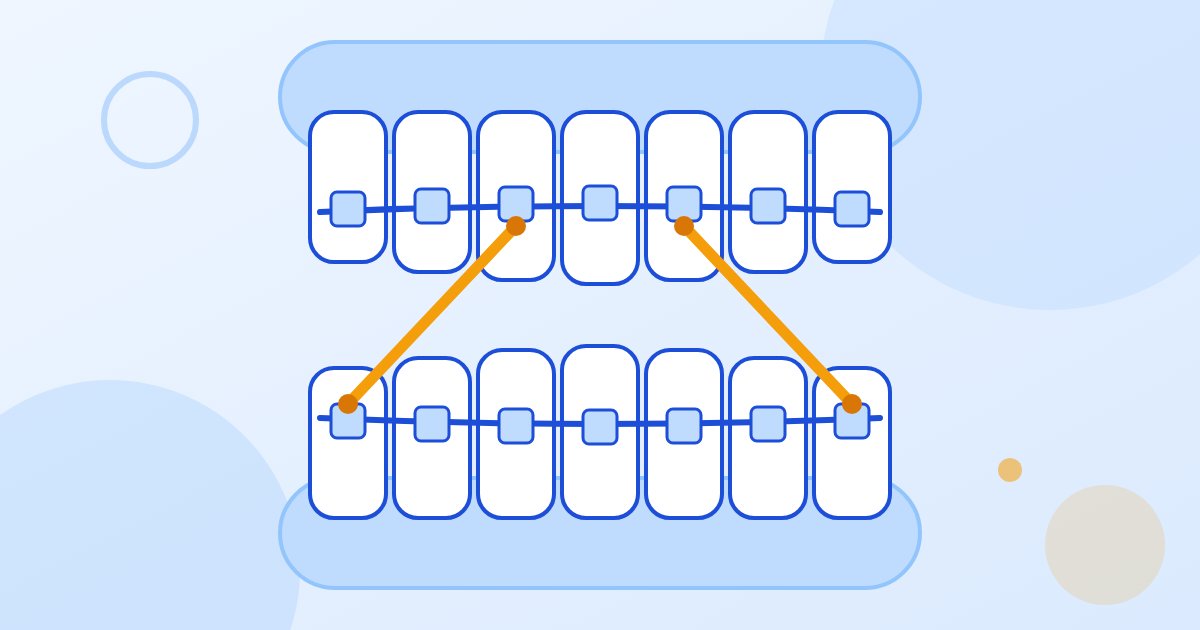
Run from a hook near the upper canine diagonally down and back to a hook on the lower first or second molar. They pull the upper front teeth back and the lower teeth forward, correcting an overbite or overjet where the upper teeth sit too far ahead of the lower.
Class III elastics
The mirror image: from a hook near the lower canine up and back to the upper molar. They pull the lower teeth back and the upper forward, for an underbite.
Vertical elastics
Run straight up and down between an upper and lower tooth in the same position. They pull the teeth toward each other to close an open bite, where the front teeth do not touch when the back teeth do, or to settle the bite in the finishing months.
Triangle elastics
Hook three points: usually one upper tooth and two adjacent lower teeth (or the reverse), forming a triangle. They combine a gentle vertical pull with a slight forward or backward component, and are a favorite for seating the bite at the end of treatment.
Box elastics
Four hooks, two upper and two lower, forming a rectangle. Stronger vertical pull across a wider area, used for larger open bites or when several teeth need to be brought into contact at once.
Crossbite elastics
Run from the tongue side of a tooth in one arch to the cheek side of the opposing tooth. They correct a single-tooth or segmental crossbite where an upper tooth bites inside a lower one.
| Configuration | Direction | What it corrects | Typical duration |
|---|---|---|---|
| Class II | Upper canine to lower molar | Overbite, overjet | 4 to 8 months |
| Class III | Lower canine to upper molar | Underbite | 4 to 10 months |
| Vertical | Straight up and down | Open bite, bite settling | 2 to 5 months |
| Triangle | Three hooks, one arch to two | Bite settling, mild open bite, finishing | 1 to 4 months |
| Box | Four hooks, rectangle | Larger open bite, multiple teeth | 2 to 6 months |
| Crossbite | Tongue side to cheek side | Single-tooth or segmental crossbite | 1 to 4 months |
Durations are wide because they depend on the size of the correction, the patient's age, and above all on how consistently the bands are worn.
Sizes and forces: what the numbers on the bag mean
Orthodontic elastics are sold by two numbers: the diameter of the unstretched band, in fractions of an inch, and the force it delivers when stretched to about three times its diameter, in ounces.
- Diameter: common sizes are 1/8", 3/16", 1/4", 5/16", and 3/8". A smaller band stretched across the same distance pulls harder than a larger one, so the diameter is chosen to match the distance between the two hooks.
- Force: light bands deliver about 3.5 oz, medium about 4.5 oz, and heavy about 6.5 oz. Some brands offer 2 oz extra-light and 8 oz extra-heavy options.
The orthodontist picks the combination to land on a specific force, which is why you should never swap in a friend's bands or buy generic ones online. A band that is too heavy does not move teeth faster; it increases pain, can damage the root or bone support, and can move the anchor teeth in unintended ways.
Latex is the standard material. Latex-free bands exist for allergic patients; they lose force a little faster. Tell the office if you have ever reacted to latex gloves or balloons.
How Long Do You Wear Rubber Bands for Braces?
Hours per day: 20 to 22
The standard prescription is full time, meaning the bands come out only to eat, brush, and floss, then go straight back in. That works out to 20 to 22 hours a day. Bone remodels around a tooth only in response to steady, sustained pressure; intermittent pressure lets the tooth settle back each time and produces almost no net movement.
Months overall: typically 3 to 8
A minor finishing correction can be done in a few weeks. A moderate Class II correction usually takes 4 to 8 months. Large skeletal discrepancies, underbites in particular, can run close to a year. The typical braces timeline of 18 to 24 months already includes this phase.
Full-time phase versus nighttime phase
Many orthodontists run elastics in two stages. The first is full time, until the bite has actually corrected. The second is nighttime only, 8 to 12 hours, to hold the new bite while the rest of treatment finishes. Do not move yourself from the first stage to the second. Patients who decide on their own that it looks fixed and drop to nights only are a leading reason elastics phases double in length.
How to Put Rubber Bands On and Take Them Off
The office will demonstrate on your first day. The routine, once learned, takes about ten seconds per side:
- Wash your hands and stand in front of a mirror with good light.
- Hook the band on the upper anchor first (or whichever the orthodontist showed you), holding it between thumb and index finger.
- Stretch it down to the lower hook and seat it, checking in the mirror that it sits on the hook and not on a bracket wing or the wire.
- Repeat on the other side if your prescription is bilateral.
A small plastic hook tool comes with the first bag and makes the back molar hooks easier to reach. To remove a band, slide a fingertip under it near one hook and lift it off; do not pull it outward from the middle, which can snap it against the cheek.
Change the bands at least once a day, and ideally after every meal, because latex loses a large share of its force within the first hours of being stretched. Keep a bag in your pocket, one in your school or work bag, and one at home.
What Happens if You Don't Wear Your Rubber Bands
The bite correction stops, then reverses. Teeth that have started moving drift back within days when the force is removed, so a week off is a week lost plus ground to regain. The practical consequences:
- Treatment gets longer. Elastic phases that should take 4 months routinely stretch to 8 or 12 with inconsistent wear, and overall treatment time grows with them.
- Soreness keeps returning. Teeth adapt to continuous force within a few days. Each restart after a break brings the first-days soreness back, so part-time wearers are sore far more often than full-time wearers.
- Plan B is less comfortable. When elastics are not working because they are not being worn, the office may switch to a fixed Class II appliance, a spring device cemented to the molars that does the same job without needing compliance. It works, but it is bulkier and harder to eat with.
Rubber Bands for Braces and Pain: What to Expect
Elastics hurt at the start. The first 3 to 5 days after starting, and 1 to 3 days after each force increase, bring pressure on the anchor teeth, a dull ache in the jaw joints, and sometimes a tired jaw from the unfamiliar pull. It fades as the teeth begin to move.
What helps, in order of how much it helps:
- Keep wearing them. This is counterintuitive, but teeth adapt only if the force is continuous. Removing bands to let soreness settle and then replacing them restarts the adaptation clock every time.
- Soft, cold foods for the first few days. Cold water held in the mouth briefly calms sore teeth.
- Over-the-counter pain relief, following the package directions, for the first two or three days if that is part of your usual braces pain routine.
- Orthodontic wax over any hook that catches the cheek or lip. Hooks are the sharpest part of braces and are a common cause of elastics-related sores.
Pain that sharpens instead of fading, a tooth that feels unusually loose, or a hook bent into the cheek are reasons to call rather than wait; the orthodontic emergencies guide covers what counts as urgent.
Eating, Brushing, Running Out, and Broken Bands
Eating
Take the bands out to eat. Chewing with them in stretches and snaps them, and food catches on them. Put fresh bands in as soon as you have finished and rinsed.
Brushing
Remove them to brush and floss, then replace them. The hooks collect plaque, so give them extra attention; see the brushing with braces guide.
Running out
Call the office. Every practice hands out replacement bags free, and most will mail a bag or leave one at the front desk the same day. Ask for the name or number printed on your bag so you get the right size and force. Do not substitute any other elastic. Traveling? Take two bags.
Broken bands and broken hooks
Bands snap, especially old ones. Replace the pair, not just the broken side, so both sides deliver equal force. If a hook breaks off a bracket or a molar band comes loose, stop wearing the elastic on that side and call the office; wearing a band to a loose anchor can pull the bracket off the tooth.
| Problem | What to do |
|---|---|
| Forgot bands for a day | Put them back in now; expect some soreness to return. Do not double up to "catch up." |
| Forgot bands for a week or more | Resume full-time wear and tell the office at the next visit so the timeline can be adjusted honestly. |
| Band keeps snapping | Use fresh bands from the bag and check the hook for a sharp edge. Repeated breaks mean a call to the office. |
| Ran out of bands | Call the office for a free replacement bag. Do not use any substitute elastic. |
| Hook broke or bracket loose | Stop the band on that side, cover sharp edges with wax, and schedule a repair. |
| Pain lasting more than 5 days | Keep wearing the bands but call; the force may need adjusting. |
| Bite looks fixed already | Keep wearing full time until the orthodontist changes the instruction in person. |
| Reaction to latex (itching, swelling) | Stop and call; latex-free bands are available. |
Common Mistakes That Slow Treatment
- Doubling up. Wearing two bands per side to speed things up roughly doubles the force, which does not move teeth faster. Excess force compresses the blood supply around the root, can cause root shortening, and moves the anchor molars in the wrong direction. One band per hook, as prescribed.
- Wearing old bands. A band worn for two days has lost much of its force and is effectively a lighter band than the one prescribed. Change them at least daily.
- Wearing them on the wrong hooks. Photograph the diagram the office gives you and check it in the mirror for the first week.
- Taking them out for photos, dates, sports, or school. Each of these adds up. Bands are barely visible at conversational distance, especially clear ones on ceramic braces, and mouthguards fit over them for most sports.
- Buying bands online. Generic elastics without the right force and size are at best useless and at worst harmful. The office gives you the correct ones free.
How Much Do Rubber Bands for Braces Cost?
Nothing, in practice. Interarch elastics are a disposable supply item folded into the total orthodontic fee along with ligatures, archwires, and power chains. Replacement bags are free at every visit and on request between visits.
The real cost question is the cost of braces. In NYC, that runs $4,000 to $8,500 for metal braces and $5,000 to $9,500 for ceramic in 2026, roughly 15 to 30 percent above the national average. Orthodontic insurance, FSA and HSA funds, and in-office payment plans apply to that total fee.
One indirect cost: many NYC practices charge $100 to $250 per month once treatment runs well past the contracted time frame, and poor elastic wear is a leading cause of that.
Frequently Asked Questions
Most orthodontists prescribe 20 to 22 hours a day, removing the bands only to eat and brush. Teeth move in response to steady, continuous force, so a band worn for 10 hours and skipped for 14 accomplishes little. Some patients graduate to a nighttime-only phase near the end, but only after the bite has corrected and the orthodontist confirms the change.
Typically 3 to 8 months, though the range runs from a few weeks for a minor bite tweak to a year or more for a large Class II or Class III correction. The single biggest factor is compliance: patients who wear their bands as prescribed finish on the shorter end, and every skipped day adds time rather than just pausing progress.
The bite correction stalls, and teeth that had started to move drift back, so you lose ground rather than just pausing. Treatment gets longer, often by months. Inconsistent wear also means each restart brings the soreness back, because the teeth never adapt. In stubborn cases the orthodontist may switch to a fixed appliance that does not rely on compliance.
Class II elastics run from a hook on the upper front teeth (canine area) down and back to the lower molars, pulling the upper teeth back and the lower teeth forward to correct an overbite or overjet. Class III elastics run the opposite direction, from the lower canine area up and back to the upper molars, to correct an underbite. The orthodontist chooses the direction based on how the jaws sit.
Expect soreness and jaw fatigue for the first 3 to 5 days after starting or after a force change, similar to an adjustment visit. It fades as the teeth begin moving. Removing the bands to let the pain settle is the one thing that makes it worse, because the teeth never adapt. Soft foods, cold drinks, and over-the-counter pain relief used as directed cover most patients.
No. Interarch elastics are a standard supply item included in the total braces fee, which in NYC runs $4,000 to $8,500 for metal braces and $5,000 to $9,500 for ceramic in 2026. Replacement bags are handed out free at every visit, and most offices will mail or hand you more between visits at no charge if you run out.
Sources
1. American Association of Orthodontists. "Braces and Orthodontic Appliances: Patient Guide." AAO.org, 2025.
2. American Dental Association. "Braces and Orthodontics." MouthHealthy.org, 2025.
3. Cleveland Clinic. "Braces: Types, How They Work and Care." Health Library, 2024.
4. Peer-reviewed literature on orthodontic elastics indexed on PubMed, including studies on latex and non-latex elastic force decay over 24 hours of wear and on patient compliance with interarch elastics as a predictor of treatment duration.
Find an Orthodontist in NYC
Compare top-rated orthodontists across the five boroughs. Most offices offer free consultations and will walk you through your full treatment plan.
Find a Provider in NYC